Baby-making R&B jams from the ’90s throb faintly through the ceiling speakers as the blinds strain against the sweltering summer sun. Red leather booths squeak under shifting bodies. Cat-shaped robots glide between tables, serving coffee and morning hot dogs. Japan’s closest approximation to the American diner, a family restaurant masquerading as something familiar.
Across the room, an old man in a windbreaker bends over a paperback. A quiet gesture of solidarity: proof I’m not the only one here to read before the noon invasion of salarymen. For now, the place holds its breath. A lull before damp laborers with white towels draped over sweat-slick shoulders shovel down set lunches, before office workers in lanyards flee cubicles in packs for thirty minutes of anonymity.
And then come the obāsans. Always the obāsans. Louder than Tokyo’s usual register, their voices slice the air with surgical precision. One woman nearby hits a pitch so sharp I swear it pierces glass, the highest note in all of Kantō. My plan to finish Pale Fire crumbles. Time to begin.
Today’s plan: to walk the demon gate.
The kimon, the northeast axis of old Edo, the unlucky direction in Chinese geomancy, the gate of oni. Here, the Tokugawa shogunate planted temples and shrines to fortify their capital against spirits believed to slip through cracks in the city. I’ve been writing about these places for work, dispatching serviceable travel articles about incense and stone lanterns. Somewhere in the accumulation of visits, I’ve developed the uncomfortable suspicion that something is actually there.
This is not something I particularly want to investigate. But after six years in a land steeped in ambiguity about the unseen, I feel compelled.
I arrived in Japan an atheist, dabbling in everything but Christ, mocking the faith of my childhood until the inexplicable humbled me. My Guardian Angel has been carrying weight for decades. I no longer wish to add to it. Enough shrinking from shadows. Time to test myself.
I should mention: I’m also aware of how this sounds. A man in a family restaurant in Tokyo, psyching himself up to walk a feng shui axis. I note this with full knowledge that it is slightly ridiculous and proceed anyway.
At Shinjuku Station, the Yamanote train pulls in at car eleven. Eleven stops at Uguisudani. An eleven-minute walk to the first temple. The repetition feels like something that may mean nothing. A girl boards behind me, a silver cross glinting at her neck. Reassurance.
Weather Plus on the overhead screen flashes a red sun icon: 34°C, 72% humidity. My back is already soaked. I’ve committed to all black, no shorts. I carry a motorized fan borrowed from my wife, the kind of gadget I swore I’d never carry, a schoolgirl’s toy. Why today? Why not wait until autumn? Because waiting is another name for never. Today I go full Gorilla Biscuits. Today I start.
Kan’ei-ji
Uguisudani greets me with a Lawson convenience store squatting outside the station, its neon buzzing against heat rising off the concrete like steam from a skillet. North of Ueno Park, the neighborhood is thick with love hotels, territory my former self would have haunted at night, back when I believed in nothing, not even morals. By day, it’s a ghost town, but the air still carries the residue of the sex trade, an invisible heaviness.
I duck into an alley, climb stairs to a bridge, pass rows of red-bibbed Jizō statues, guardians of children in the afterlife according to Buddhist belief, cut through a graveyard, and slip through Kan’ei-ji’s rear gate.
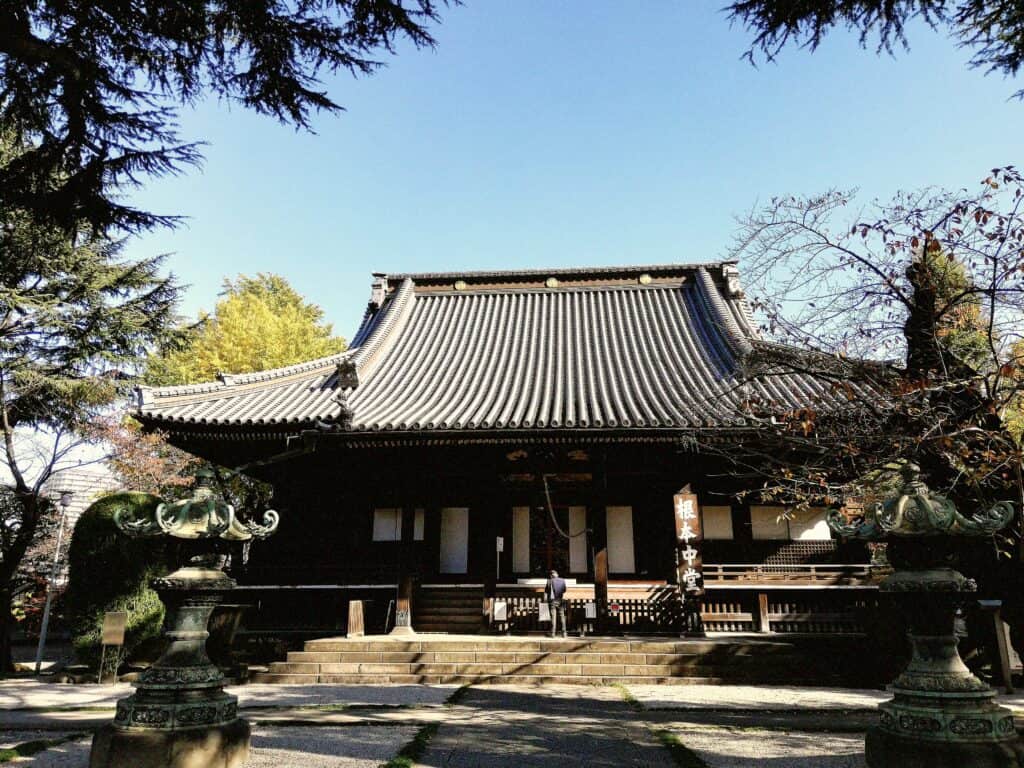
Incense clouds the main hall. Statues line the back wall beyond the barred tatami platform, mute and watchful. I hover, unsure. Not here to worship, but respect is expected. Years ago, I would have bowed reflexively, without thought. Now I only pocket brochures, then step back into the glare.
The grounds are nearly deserted. Four housewives advance beneath white umbrellas, coins clutched in hand, trailed by an older man in a one-piece work outfit. They approach the prayer bell beneath an intricately carved roof where sharp-mouthed beasts leer down. The gravel path crunches under my shoes.
Next door, a kindergarten lies abandoned for summer break, silence spilling onto the temple grounds as if childhood itself has leaked into the precinct. A woman in a purple kimono sits motionless at the amulet stall. Cicadas saw through the air above her. A lone car rattles past on the outer street.
Kan’ei-ji was founded in 1625 by the Tendai monk Tenkai, spiritual advisor to Tokugawa Ieyasu. As Enryaku-ji shielded Kyoto from the northeast, Kan’ei-ji was built to protect Edo from the kimon. At its peak, it spanned ninety acres, the entire footprint of what is now Ueno Park. Where pandas, museums, and buskers now roam, shoguns once prayed and were eventually buried.
I sit on the steps of the main hall. Cicadas and birds swell into a single chorus, the hum of high summer. A wrong turn delivers me to the public cemetery, where the sun bounces off stone and concrete, punishing. I pull my komboskini from my pocket, turning it over like a talisman. The marble tombs look mass-produced, machine-perfection, standing where grief should be. I retreat. A construction worker directs me back. On the way, I pass a trailer where four white-collared men sip green-tea juice boxes with a monk in full regalia: commerce and prayer trading favors in the shade. The mausoleum is sealed, the gate locked.
This ground was a battlefield in 1868. Tokugawa loyalists, the Shōgitai, an elite corps of samurai, barricaded themselves in this area and made their last stand. Fire swept through. The temple burned. The Meiji government expropriated the land and made it a park.
Yet Kan’ei-ji endures. A laborer still rings the bell. Housewives still toss coins. The cicadas climb in waves of sound like choirs Pythagoras might have mistaken for the music of the spheres. At the edges, children still play. Kan’ei-ji is not a monument to ruin but a contradiction: battlefield turned schoolyard, ruin that still prays.
Ueno Tōshōgū
Ueno Park on a Tuesday is sleepy. A woman in Heisei-era clothing perches on a rock with her notebook, good on her. A man in a blue Hawaiian shirt sits cross-legged under a tree, eyes closed, polyester flapping in a breeze too faint to matter. I recognize the performance. In my TM days, I did the same, posing as spiritual, hoping passersby would register enlightenment. On a bench, an old man slouches forward, draining what I suspect is his third 9% chu-hai of the day. A path I might have taken had I never traded hedonism for faux-asceticism.
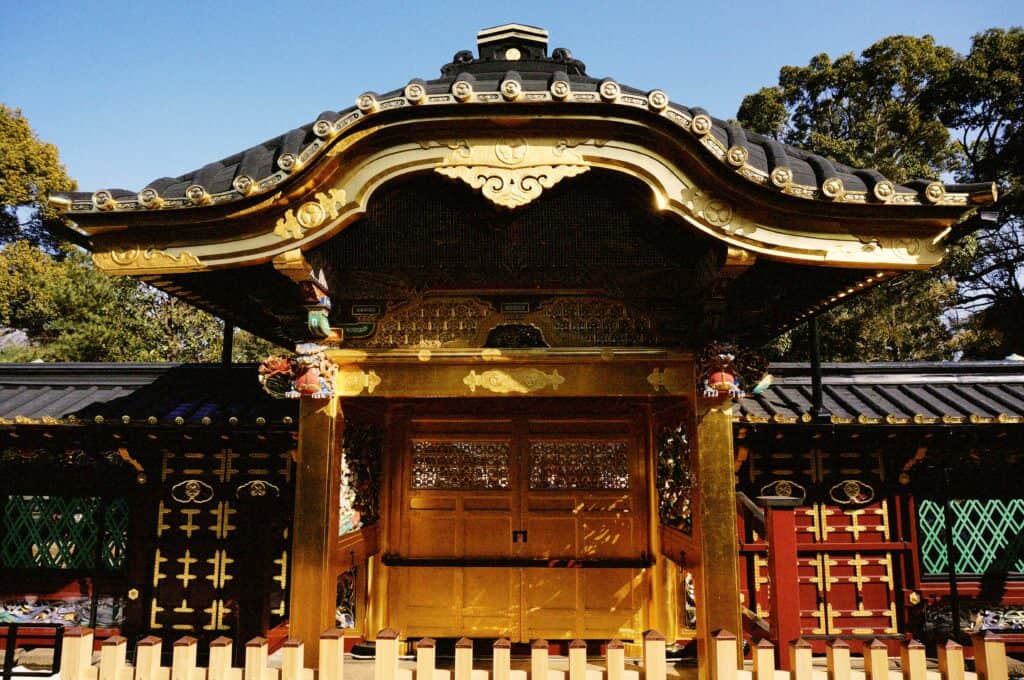
Past the statue of Prince Komatsu Akihito, past the panda zoo, past the five-story pagoda that was once Kan’ei-ji’s and is now caged with animals, stands Ueno Tōshōgū. Tokugawa Ieyasu, first of his line, unifier of Japan, is enshrined here in gold and cedar.
At the torii, I stall at a vending machine. My wife has begged me to wear sunscreen for years, and I always refuse. Now my arms flush pink, genetics punishing me for the vanity of wearing all black in August. I buy Calpis water instead of real water. Chalky, white, vaguely sweet hydration or a placebo.
The approach: a tall stone torii, a cobblestone path, and over 200 copper lanterns donated by feudal lords. Among them, the enormous ghost lantern, one of the largest in Japan, looms like a warning. Ahead, the karamon gate gleams gold, carved with phoenixes, hawks, and peonies. Legend says the dragons etched there shift their form when the light strikes just right.
A European tourist splashes his face directly into the purification basin, no ladle, no decorum. A group of Chinese visitors bows and claps once. Do they know the correct ritual? Perhaps it doesn’t matter. I pay the ¥500 and step into the inner precinct. By now, I am a wet monster, dripping.
I collapse into the shade of a modernist shelter. Behind me rises Ueno’s oldest camphor tree, six centuries old, its trunk roped with shimenawa. I raise my Kodak to photograph it. The film jams instantly. Operator error, or the unseen intervening? Either way, I’m finished with analog nostalgia. Film and vinyl always defeated me. Pen and paper never skip.
In a corner, a small tanuki shrine crouches. Once a nuisance to the Tokugawa, the trickster raccoon-dog was enshrined during the Taishō era to pacify it. Now, students pray here for exam scores and job interviews. I think of the tanuki from the movie Pom Poko parachuting with their scrotums, absurd creatures conscripted into career counseling. The juxtaposition is sharp. This shrine has survived the Great Kantō Earthquake, wartime firebombs, and urban redevelopment. I can’t stand sunscreen.
Nezu Shrine
I’m still sulking about the camera as I walk toward Nezu, where the old city lingers beyond scaffolding and glass. Another graveyard, then a beauty salon called Angel. On the pavement, a stomped-on carton of Hope cigarettes. Angel and Hope, side by side. The city throws signs if you’re paying attention. If I relied on photographs, I’d miss them. I’d grow lazy about the details.
The streets knot tighter the closer I get to the shrine. My phone dies. No more maps. I wander blind. Another turn, another sign: a shuttered storefront labeled Wingman: Museum of the Tenshi. Tenshi, angel. Behind glass, Renaissance cherubs peer out, plump and watchful, their marble eyes fixed. My grin widens.
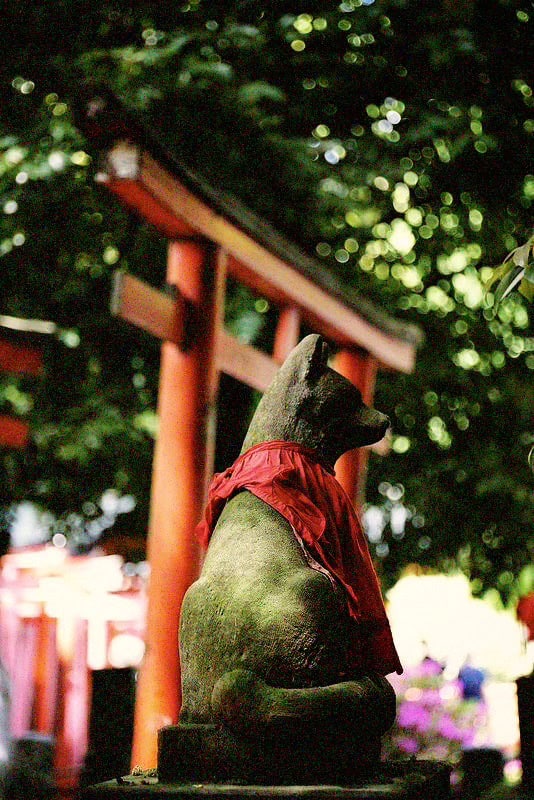
At last, Nezu Shrine. The foxes guard the entrance. I duck under the Senbon Torii, the corridor of cinnabar-red gates, trying to limbo through without bowing, but my head knocks a beam. Reflexively, my hand rises in the Sign of the Cross.
This shrine is consecrated to Susanoo-no-Mikoto, the storm deity and brother of Amaterasu. Legend traces it back nearly two millennia to Prince Yamato Takeru, notorious for his temper and violence, the prince who disguised himself as a woman to assassinate enemies at a banquet and cut through fire itself with a divine sword. Families replace warriors now. An ambiguous European father shepherds three boys across the grounds. Their mother doles out coins for the offertory box, the youngest pouting as if the divine were just another errand.
In 1705, the fifth shogun, Tsunayoshi, moved the shrine here, and his adopted heir, Ienobu, bound himself even more deeply, his placenta buried beneath the grounds, his bloodline fused into the soil. Beneath these stones lies a piece of a shogun’s body. The architecture above it has survived earthquake and firebombing intact. Somewhere in that combination, the buried body and the surviving structure, there is a logic I can’t fully articulate but feel standing here.
I rest on a stone bench in the shade. A sudden gust whips leaves into a spiral around my feet, then collapses into suffocating stillness. White paper fortunes flutter from cords like laundry, trembling with prayers. On the bridge, koi circle with turtles. There is always construction in Tokyo, at shrines, beside shrines, on the way to shrines. Always a senior man with the cushy post of guard while younger men labor. A stone fox grins knowingly.
Kanda Myōjin
I sulk over the broken camera until my eyes land on rare litter: a business card stamped SMILE Hair Salon. The world throws signs if you’re watching. I glance up, and the station chime rings right on cue.
I stray down the wrong street and stumble upon Nezu Kyōkai, a Protestant-looking church with a cross on a red triangle roof. The door is welded shut. Through the keyhole, faint lights flicker, but the peeling paint insists otherwise. Down the block, a takoyaki stand decorated with toy dinosaurs glares in the midday sun. My phone is dead. I stop a woman for directions. Startled, she gestures silently, wary of intrusion.
Doubt begins to seep in on the subway platform. A man in a black HEADSTRONG T-shirt strides by. I sprint for a train. Doors slam shut behind me. Wrong line. I mutter to myself: Stop rushing. Two schoolgirls fan themselves with motorized fans like the one I abandoned hours ago. Theirs gleam silver, studded with rhinestones. A ghost train glides past, empty, its sign reading Out of Service.
When I surface, I’m on the edge of Akihabara, a district with Tokyo’s strangest smell until you compare it to Kawasaki and remember New Jersey. At 7-Eleven, I bypass water for an açaí-banana smoothie, chugging it down in six gulps. Journalism? Maybe. Maybe not. I’ve never done this before.
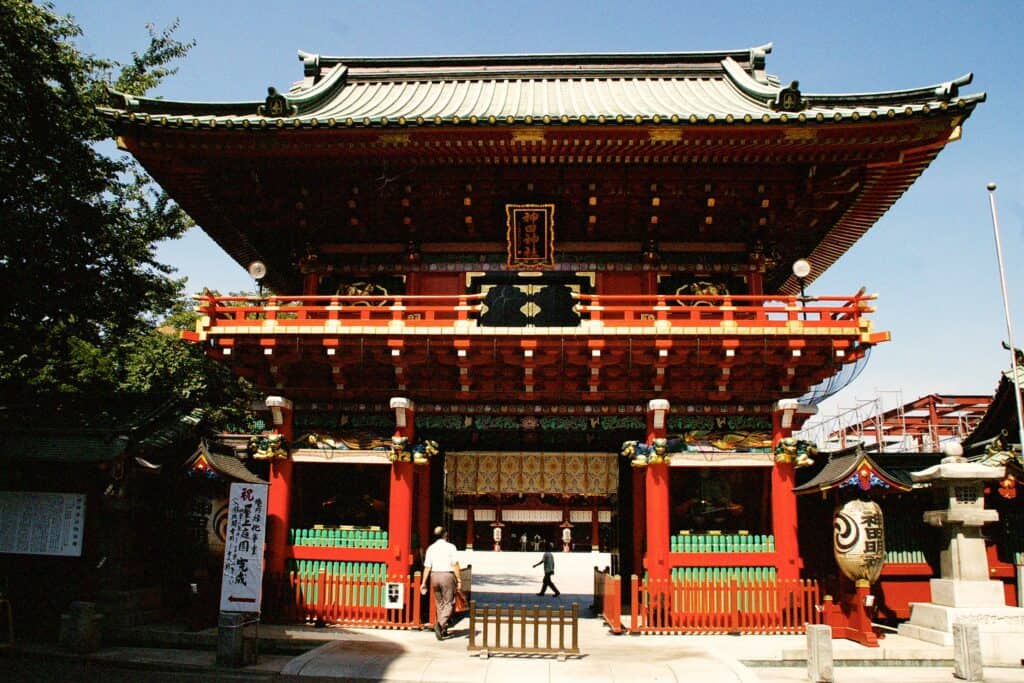
The back staircase of Kanda Myōjin rises before me. Inside: loud, colorful, alive. The gift shop resembles an amusement-park stand. A woman bows rhythmically before the main hall. Beside her, a tattooed woman prays with equal fervor. Later, she meets my gaze directly, unflinching.
I corner a priest with Jimmy Neutron hair and ask, in halting Japanese: Is this the demon gate? He nods once. Confirmation.
The designated smoking section seethes with salarymen, shoulder to shoulder, exhaling clouds upward. Their eyes speak more than incense. Nearby, a massive boulder sits labelled only in English: Power Stones. Vividly painted horses guard the gate. Briefcases swing past. Rush hour presses closer.
Kanda Myōjin was founded in 730. Its three enshrined figures include Taira no Masakado, the Heian-era rebel whose severed head flew across the country under its own power, and whose grave in Otemachi, ten minutes from here, has accumulated a documented century of misfortune for those who disturbed it. The Meiji government removed him from the main shrine because of the political inconvenience of his rebellion, and he was reinstated in 1984 after decades of incidents attributed to his displeasure. Even now, office workers in the surrounding financial district tread carefully near his mound. Television producers visit before any program features his name.
This shrine was placed here to guard the demon gate. After thirteen centuries of practice, it still is.
St. Nikolai → Taco Bell
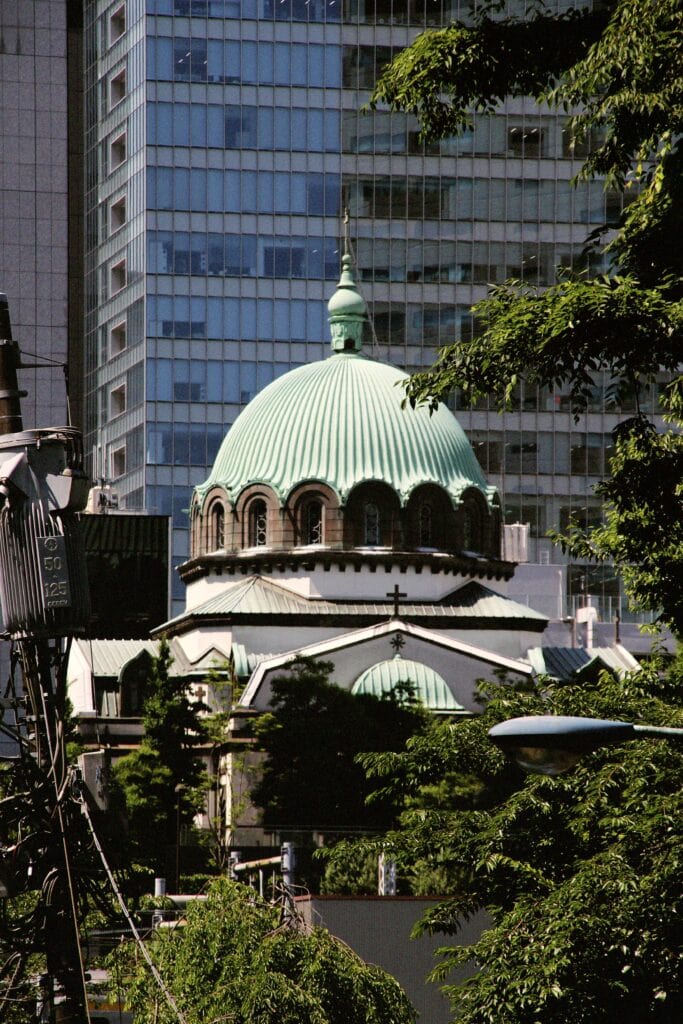
The sun dips as I cross Hijiri Bridge. Ahead, the onion-shaped dome of St. Nikolai Cathedral crowns the skyline, a beacon in fading light. On a bench, a homeless man sprawls belly-up, limbs flung starfish-wide. Two Jehovah’s Witnesses patrol Ochanomizu Station, pamphlets at the ready. One glance from me and they pounce. I slip past, eyes fixed on the dome.
A mural on the wall above the bridge catches me, twelve figures around a central man. For a moment, I mistake it for Christ and the Apostles. Up close, it’s only a dental school advertisement. I continue to the cathedral. The doors are locked. I bow before the cross above its gate anyway. A salaryman pauses, watching me as if I’ve gone mad.
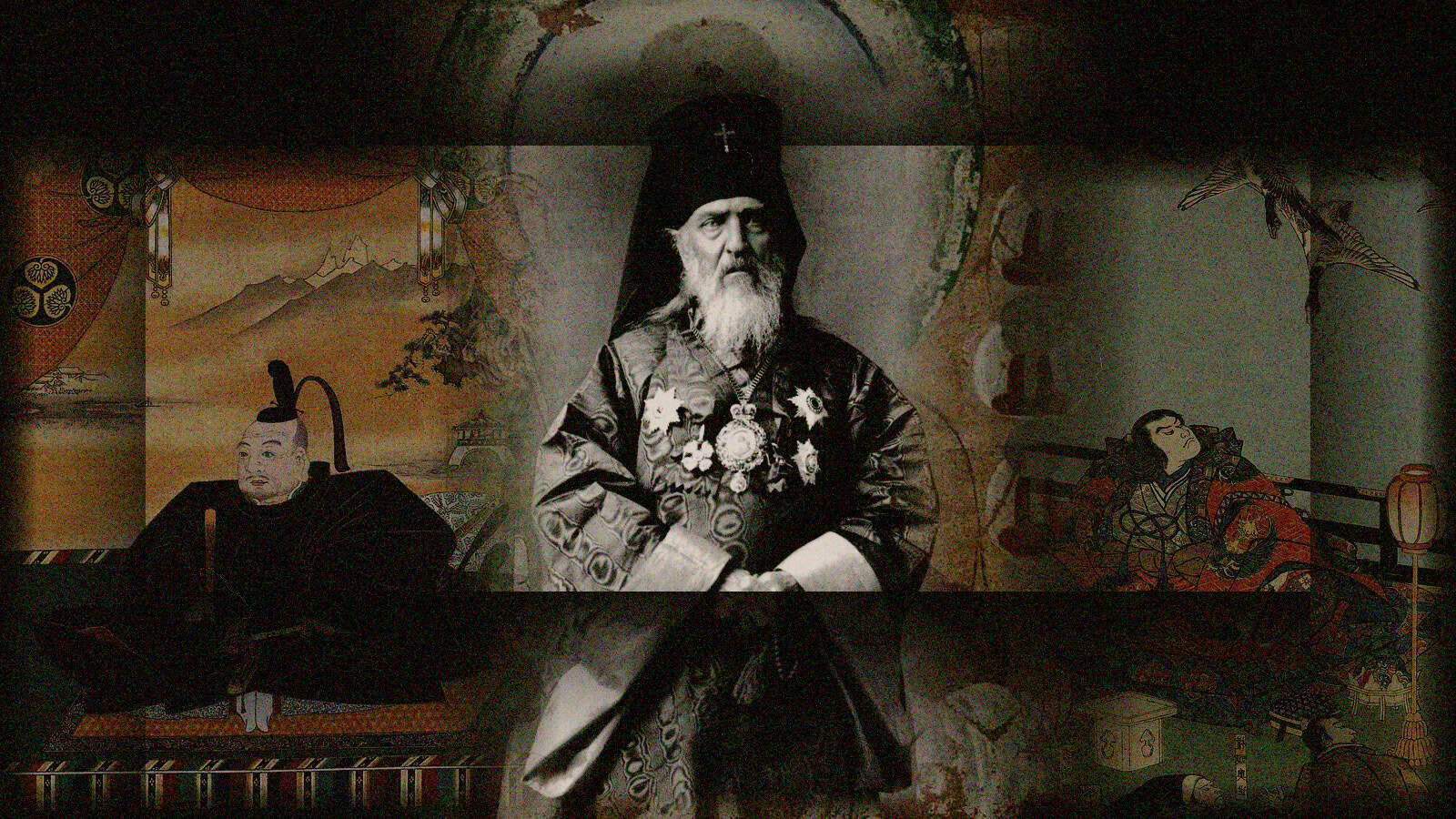
St. Nikolai, Nikolai Kasatkin, arrived in Japan in 1861, knowing neither the language nor the culture, knowing almost nothing. He spent his first years simply studying, doubting whether the harvest would ever come. He despaired of resources and considered leaving. He stayed, built, and eventually the Orthodox Church in Japan became real enough to survive him. His cathedral still rises above Ochanomizu, its dome visible for some distance in every direction.
My general impression, he wrote in his journal, is that the Lord wants the True Faith to take root in Japan. He wrote this early, before he had much evidence for it. Faith as a working hypothesis. I recognize the posture.
Dinner is a kilometer away in Jimbochō; breakfast at Gusto; dinner at Taco Bell. Fast food galore. The demon gate holds.
On the walk, I stop again. Graffiti: a skull with angel wings bursting from its eyes, painted high, impossible without scaffolding. To my right, a Saizeriya window frames a plaster cherub locked in a frozen embrace. Angels again. Everywhere, angels, cheap restaurant cherubs, street graffiti, shuttered Tenshi museums, littered SMILE cards. Signs scattered like breadcrumbs, or like something else.
I step through Taco Bell’s glass door. Fluorescent light washes over plastic tables. After deliberation, I ordered a quesadilla. The register beeps.
Above the counter, the day’s final sign: Live más.
The places visited on this walk have their own articles on this site: Kan’ei-ji Temple, Ueno Tōshōgū, Nezu Shrine, and Kanda Myōjin. Each one earns a slower visit than this walk permitted. Start here. Go back.