Past the bronze statue of Prince Komatsu Akihito, the imperial commander who fought to end the shogunate and whose presence here marks the precise moment the old order gave way, the path curves toward the zoo, where Tokyo’s beloved pandas draw their daily crowds. The five-story pagoda rises above the treeline beyond the zoo fence. And tucked against the hillside, half-hidden by stone lanterns and centuries of accumulated reverence, stands Ueno Tōshōgū: the golden shrine to the man who started it all.
Tokugawa Ieyasu unified Japan after a century of civil war, founded the shogunate that would govern for over 250 years, and died in 1616. He is enshrined here. Most of the park’s visitors walk past without stopping.
The Shrine That Shouldn’t Exist Here
Ueno Tōshōgū has layers that reward understanding. The shrine did not emerge from the ground on its own. It was built in 1627 by Tōdō Takatora, a daimyo and one of Ieyasu’s most loyal commanders, on land he donated at the shogunate’s request. That land was then incorporated into the vast Kan’ei-ji temple complex, which was being constructed around it. A Shinto shrine within a Buddhist temple complex: this was entirely normal in 17th-century Japan, where the two traditions were so thoroughly intertwined that the same structures often served both.
The current buildings date to 1651, when the third shogun, Tokugawa Iemitsu, Ieyasu’s grandson, ordered Ueno Tōshōgū rebuilt in the extravagant style of the great Nikkō Tōshōgū to the north. The intent was democratic, in its way: Edo’s residents should be able to honor Ieyasu without having to travel days into the northern mountains. The result is one of the finest examples of early Edo architecture still standing in Tokyo.
It survived the Battle of Ueno in 1868, when the surrounding temple complex burned. It survived the Great Kantō Earthquake in 1923. It survived the 1945 firebombing, when a bomb fell directly behind the main sanctuary and did not detonate. Whether you attribute that to structural luck, divine intervention, or the particular stubbornness of gold-leaf architecture is a matter of personal inclination.
The Path In
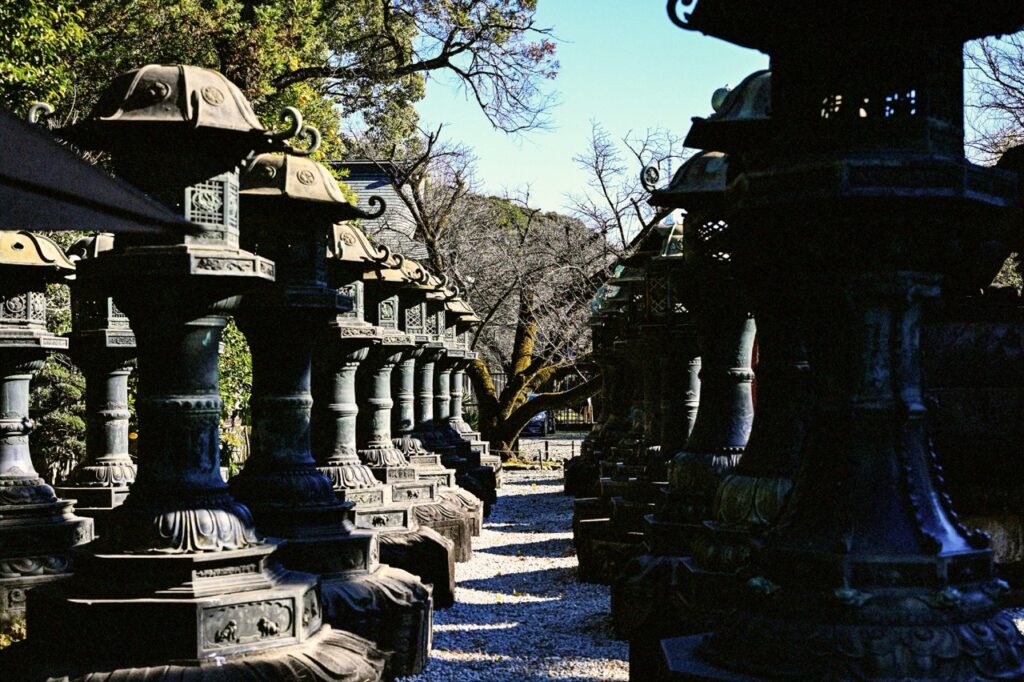
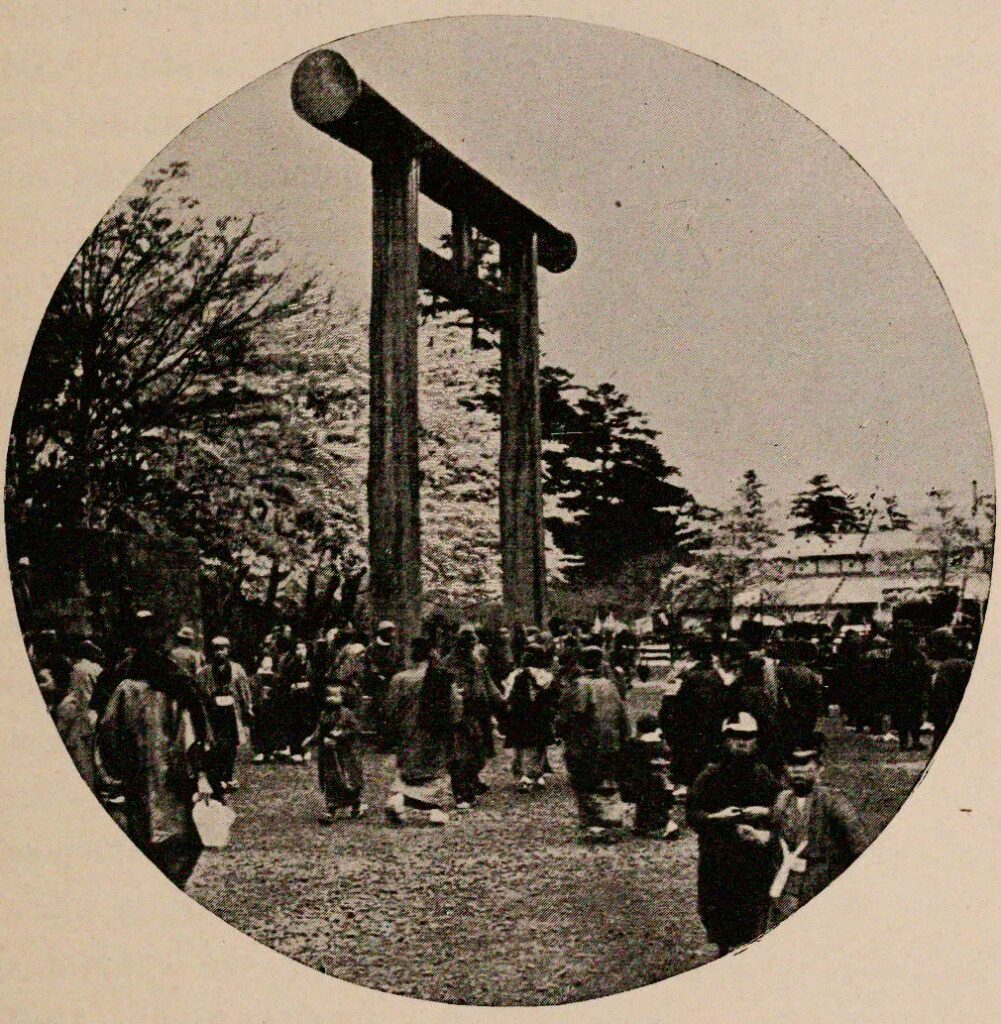
Pass under the tall stone torii. This gate also stood through the 1923 earthquake, while others around it collapsed. Walk the cobblestone path between the lanterns. There are over 200 of them: stone ones lining the approach, 48 bronze ones closer to the shrine, all donated by daimyō from across Japan. The sheer accumulation of them, stretching toward the karamon gate at the end, gives the approach a quality that is difficult to describe, ceremonial without being theatrical, powerful without announcing itself.
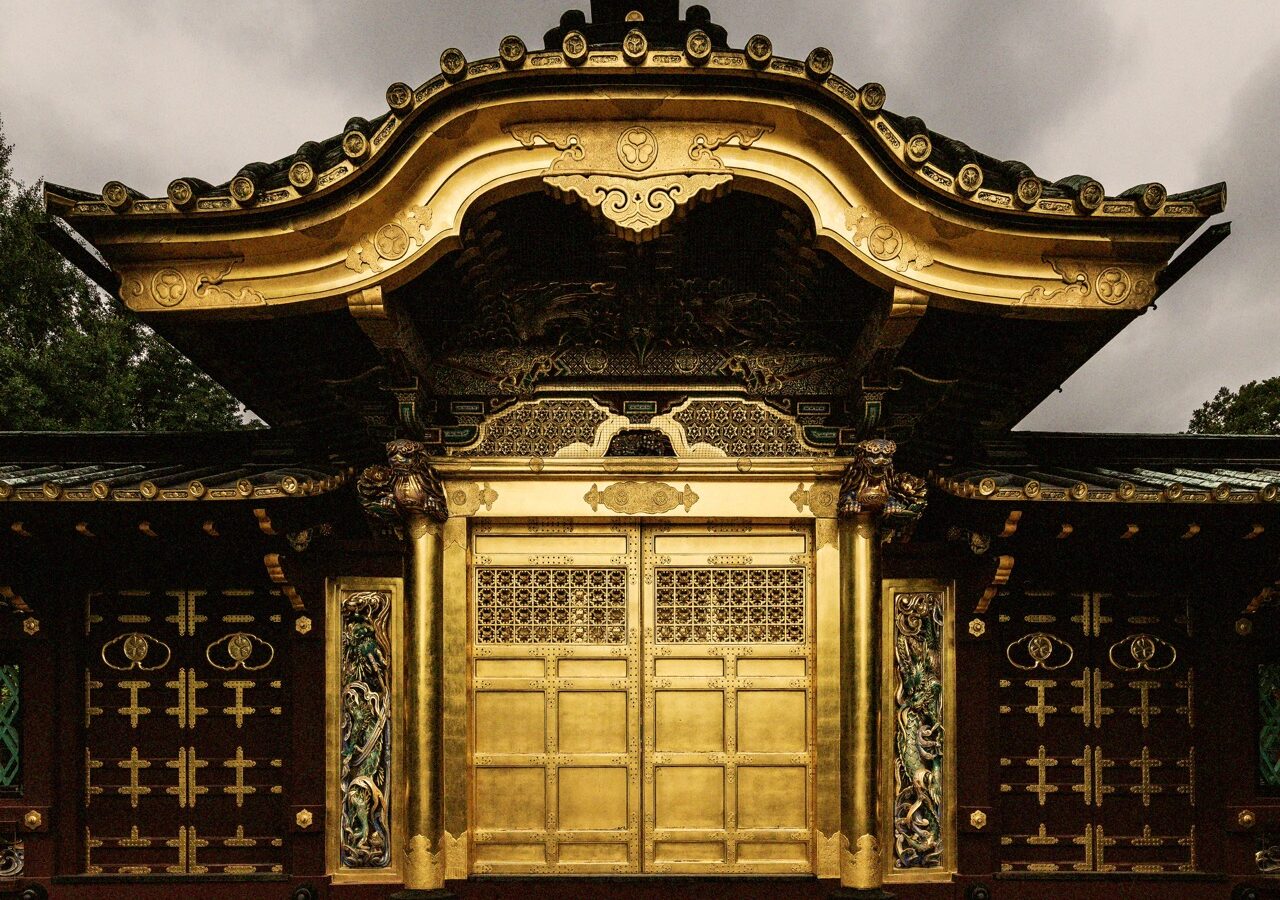
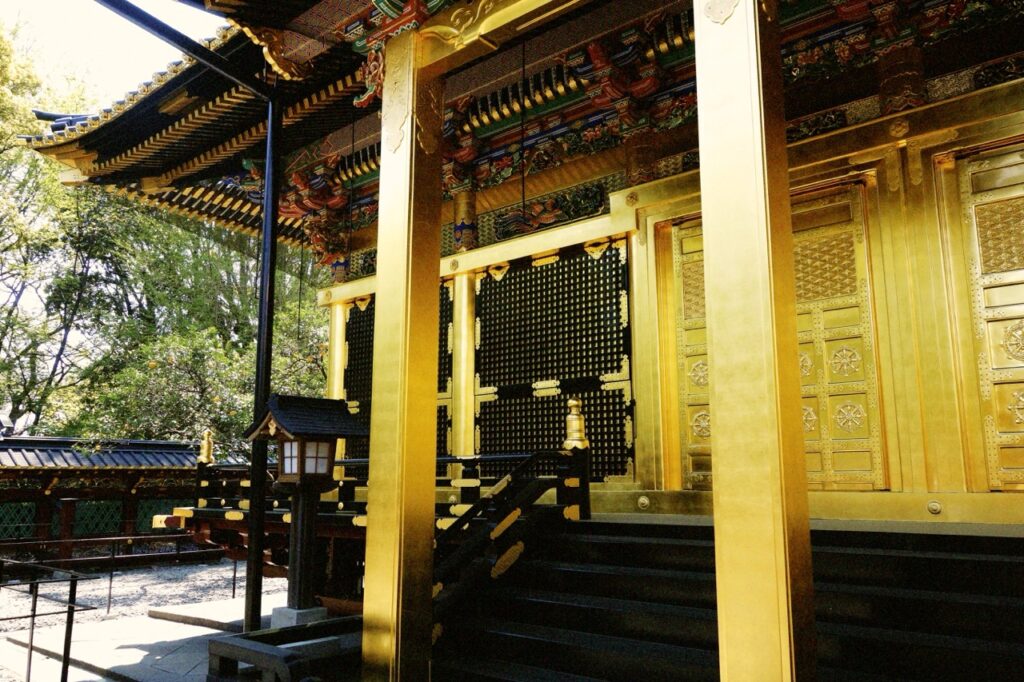
The karamon gate at the end of the approach is where the shrine declares itself fully. Gold leaf. Intricate carvings of hawks, phoenixes, peonies, and Chinese guardian lions. The twin doors bear the Tokugawa crest. The dragons carved into the columns flanking the gate are said to move, swirling through the gold panels when viewed at the right angle in the right light. This is attributed to the legendary Edo-period craftsman Jingoro Hidari, whose carvings at Nikkō carry the same reputation. Whether the movement is real or a quality of the gold in changing light, visitors consistently report seeing it. I did not disbelieve them.
The Pagoda and the Lie That Saved It
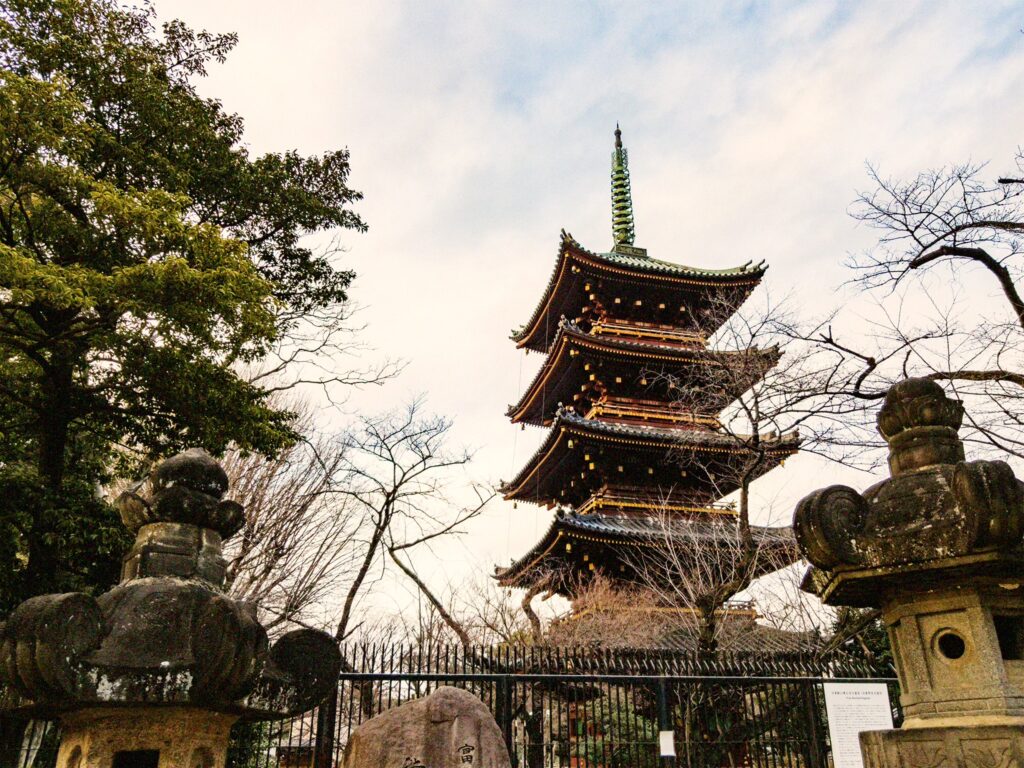
Just visible above the zoo fence, the five-story pagoda has its own story, one that the park’s signage does not clearly tell.
Originally part of the Tōshōgū shrine grounds, the pagoda stood in its current location from 1639 (rebuilt after an earlier version burned). The two traditions, shrine and temple, coexisted without friction for two centuries. When the Meiji government came to power in 1868 and imposed the forcible separation of Shinto and Buddhism, Buddhist structures on shrine grounds across Japan were destroyed en masse. Bronze bells were melted down for cannons. Statues were smashed. The pagoda should have been demolished.
The head priest of Ueno Tōshōgū saved it with a bureaucratic maneuver: he filed an official report declaring the pagoda the property of Kan’ei-ji Temple rather than the shrine. The authorities accepted this. The pagoda was reclassified, transferred, and survived. In 1958 Kan’ei-ji donated it to the Tokyo Metropolitan Government, which incorporated it into the zoo that had grown up around it. The zoo was built around the pagoda. The pagoda has not moved.
The Inner Grounds
The ¥500 admission to the inner grounds is worth paying, if only to stand before the main sanctuary up close. The three sealed chambers, the worship hall, the offering hall, and the inner sanctum housing Ieyasu’s spirit, are not open to the public. People bow and clap before the closed doors anyway, sending their wishes into the sealed void. Longevity. Health. Prosperity. Success. The usual human requests, addressed to a man who has been dead for four centuries.
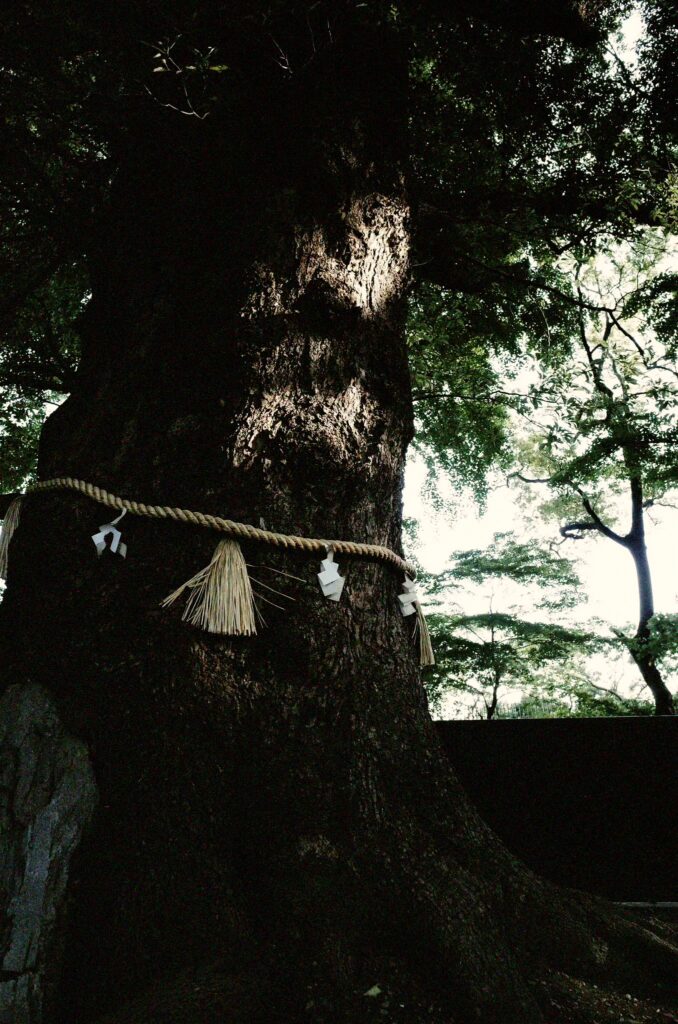
Near the entrance to the inner grounds stands the oldest tree in Ueno Park: a camphor tree estimated to be over 600 years old, considerably predating the shrine itself. It is wrapped in a shimenawa, the sacred Shinto rope that marks the presence of a divine spirit. The trunk is about eight meters in circumference. When I tried to photograph it with my film camera, it stopped working. Perhaps I loaded the film poorly. Perhaps something else. You decide.
In the shadow of the camphor tree is a small subsidiary shrine: the Eiyo Gongen-sha, dedicated to a tanuki, a raccoon dog, a creature associated in Japanese folklore with mischief, transformation, and the disruption of the natural order. The shrine’s history is unusual: the tanuki was historically regarded as troublesome when enshrined, and this one was said to have caused various problems on the Ueno grounds until it was formally consecrated during the Taishō era, after which it apparently settled down. Students now come here to pray for exam results and job interviews. The pacified trickster god as career counselor: this is Ueno Tōshōgū’s particular gift for unexpected combinations.
What It Is
Ueno Tōshōgū is neither haunted nor cursed. More precisely, it is a survivor, a place that has outlasted the shogunate that built it, the temple complex that surrounded it, the earthquake, the bombs, and the pressure of modernization. The park absorbed everything around it. The shrine remains at its center, gold and intact, still receiving prayers.
It pairs naturally with Kan’ei-ji, a short walk to the northeast. One is what survived. The other is what was left. Together, they make a portrait of the same history from two directions: the Shinto shrine built by the shogunate’s daimyo and the Buddhist temple built by the shogunate’s monk, both within the same original complex, now separated by the zoo built through the middle of it.
Walking between the two is, quietly, one of the stranger things you can do in Tokyo.
Getting There
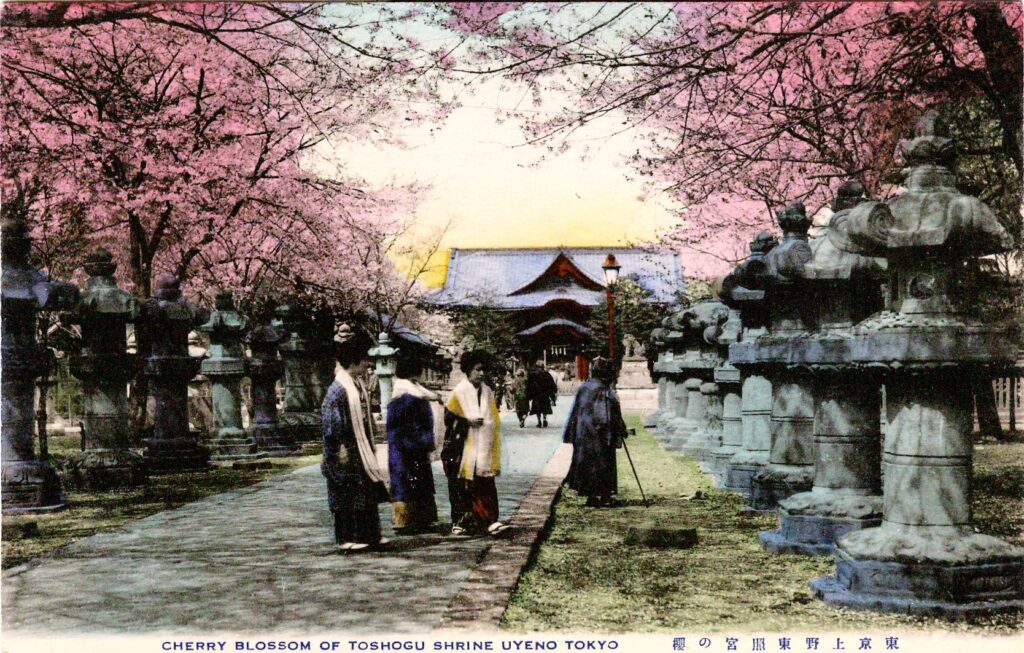
Ueno Tōshōgū is in the western section of Ueno Park, an eight-minute walk from JR Ueno Station’s Park Exit. The outer grounds are free. The inner grounds cost ¥500. The main hall is always closed; prayers are held outside the door.
Go on a weekday. The lanterns deserve to be walked in silence.
Related: Kan’ei-ji Temple — The Ghost of Ueno Park/ Harakiri Yagura — The Cave Where a Shogunate Died