Nezu is one of the few places in Tokyo where the old city still lingers in the texture of the streets. Low wooden buildings, narrow lanes, the sense that something was not demolished and rebuilt here quite as thoroughly as elsewhere. At the end of one of those lanes, behind a stone torii and a path lined with stone lanterns, stands a shrine that has accumulated history for nearly two millennia.
The Warrior Prince and the Storm God
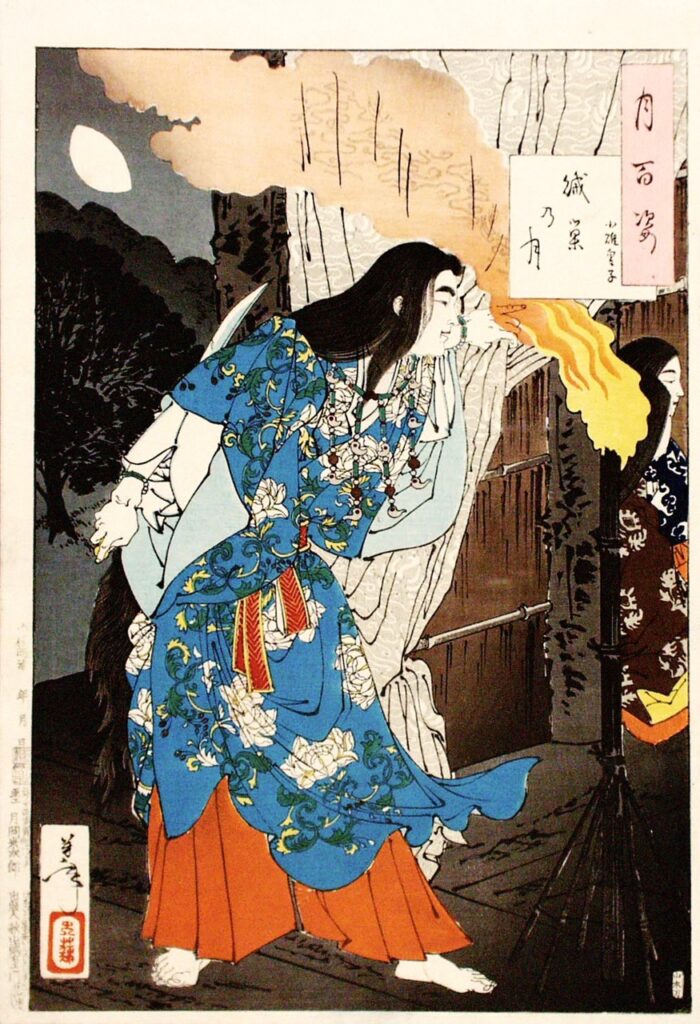
The legend places the founding of Nezu Shrine in the 1st century, when Prince Yamato Takeru, son of Japan’s 12th emperor and one of the great mythic figures in the ancient chronicles, is said to have consecrated a shrine in nearby Sendagi on his eastward journey to pacify rebellious tribes.
Yamato Takeru is no straightforward hero. His story, as recorded in the Kojiki and Nihon Shoki, is dense with violence and transformation. He disguised himself as a woman to attend a banquet and assassinate two brothers, the Kumaso chiefs, at close range. He escaped a trap in which his enemies set fire to the grass around him, using the divine sword Kusanagi to cut away the burning grass and a fire striker given to him by his aunt to turn the flames back on his pursuers. He is fierce, shape-shifting, unreliable, and brilliant, a figure who operates at the edge of human and divine, a tendency found in Japan’s oldest myths.
The deity he enshrined here was Susanoo-no-Mikoto, the storm god, the brother of the sun goddess Amaterasu, and the patron of the sea, chaos, and transformation. Not a gentle, protective deity. A force of disruption, made useful, contained within shrine walls, offered to, and asked to look favorably on the people who live nearby.
The two of them, the violent prince and the storm deity, provide an appropriate foundation for a place that has spent most of its history amid political turbulence. The shrine survived the Meiji government’s forced separation of Buddhism and Shinto, was consulted by imperial envoys during the capital’s relocation from Kyoto to Tokyo in 1868, and endured earthquakes and firebombing without losing a single original structure. Whatever it is built on has held.
The Shogun’s Nephew and the Land Beneath Your Feet
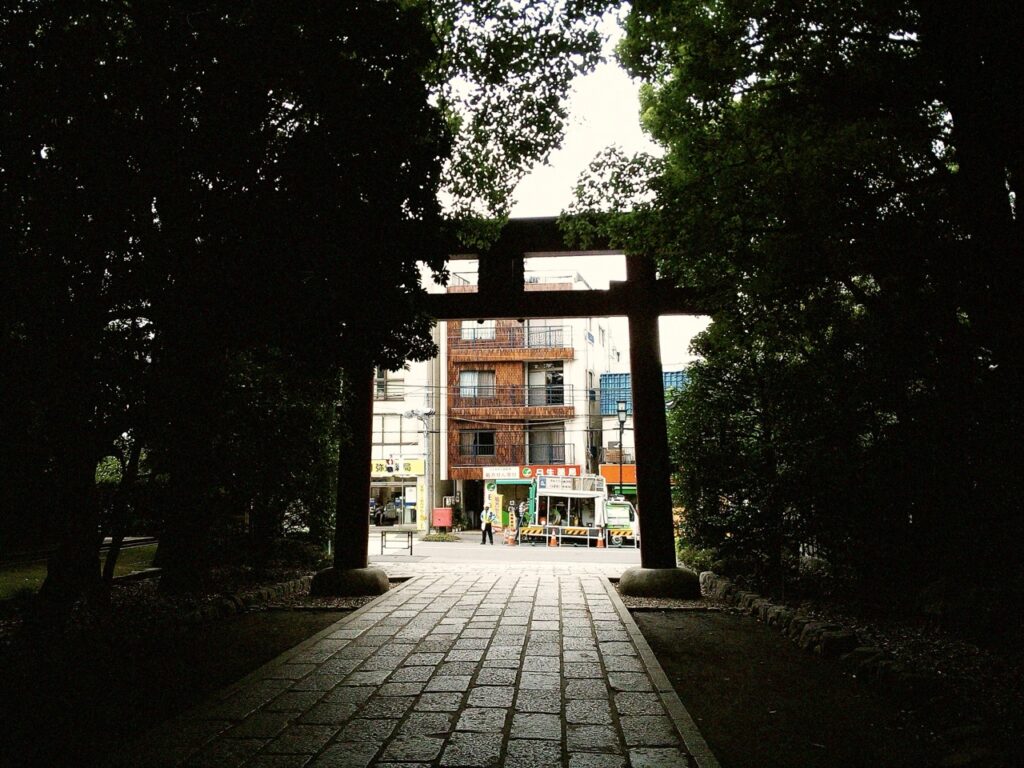
The shrine moved to its present location in 1705, and the circumstances are worth understanding.
Tokugawa Tsunayoshi, the fifth shogun, known in history as the “Dog Shogun” for his extreme edicts protecting animals, and born in the year of the dog, had no surviving sons. In 1705, he adopted his nephew, Tokugawa Ienobu, as his heir. To mark the occasion and provide Ienobu with a guardian shrine befitting his new status, Tsunayoshi relocated Nezu Shrine to its current site. The land used was Ienobu’s own Edo estate; he donated the ground where his birthplace had stood to serve as the shrine’s foundation. The buildings were completed in 1706.
This is the ground you walk on when you visit Nezu Shrine. A man’s birthplace, donated to become a sacred site in his honor.
Ienobu became the sixth shogun in 1709, following Tsunayoshi’s death. He died three years later. He is buried elsewhere, but his placenta is here.
The Enazuka
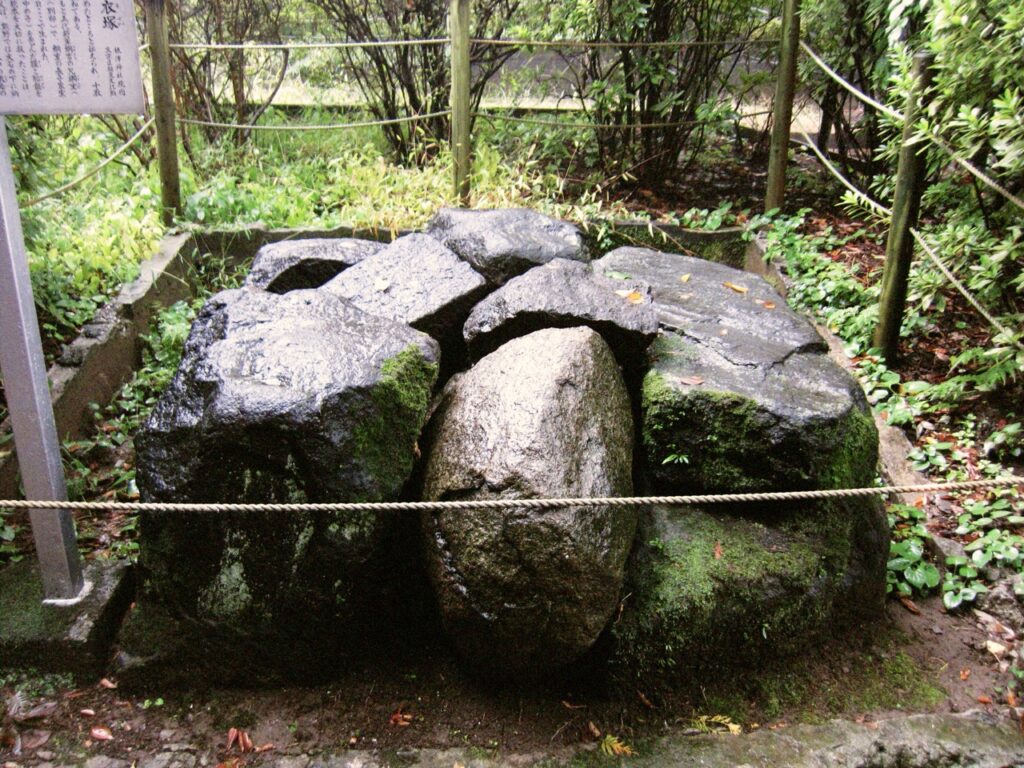
In a quiet corner of the shrine grounds, designated an Important Cultural Property by Bunkyō Ward, stands the Enazuka, the Placenta Mound of Tokugawa Ienobu.
The practice of burying a child’s placenta at the place of birth was common across many levels of Japanese society, rooted in the belief that it bound the child to the land and ensured their strength and health as they grew. For families of rank, this was formalized into a mound, a permanent marker of the biological connection between a person and a place.
Ienobu’s placenta was buried here in 1662, the year of his birth, when this ground was still his family’s estate. When he donated that estate to become a shrine forty-three years later, the placenta mound remained. It is still here. A piece of the sixth shogun’s birth, enclosed in earth, designated a cultural property, tended by people who visit a shrine without knowing what is underneath it.
There is something characteristic of how Japan holds its history in this combination of details. A battlefield becomes a park. A shogun’s birthplace becomes a shrine. The biological remnant of a man who governed Japan becomes a designated cultural property, passed by tourists on their way to photograph the foxes.
What to See
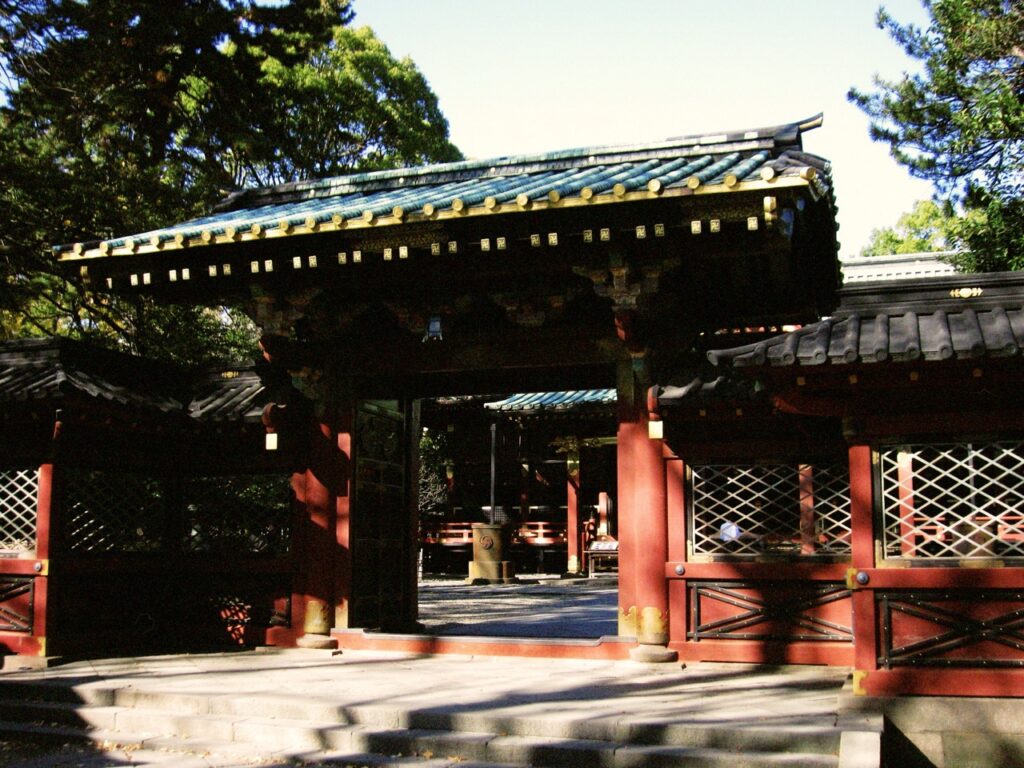
The shrine buildings, including the main hall, worship hall, Karamon Gate, and Sukibei fence, date to the original 1706 construction and survived intact through the 1923 earthquake and the 1945 firebombing. This makes them among the oldest intact structures in Tokyo. The Karamon Gate’s ceiling features an ink-painted dragon. The Sukibei, the ornate latticed fence surrounding the main complex, is modeled after the equivalent structure at Ueno Tōshōgū, built the same year.
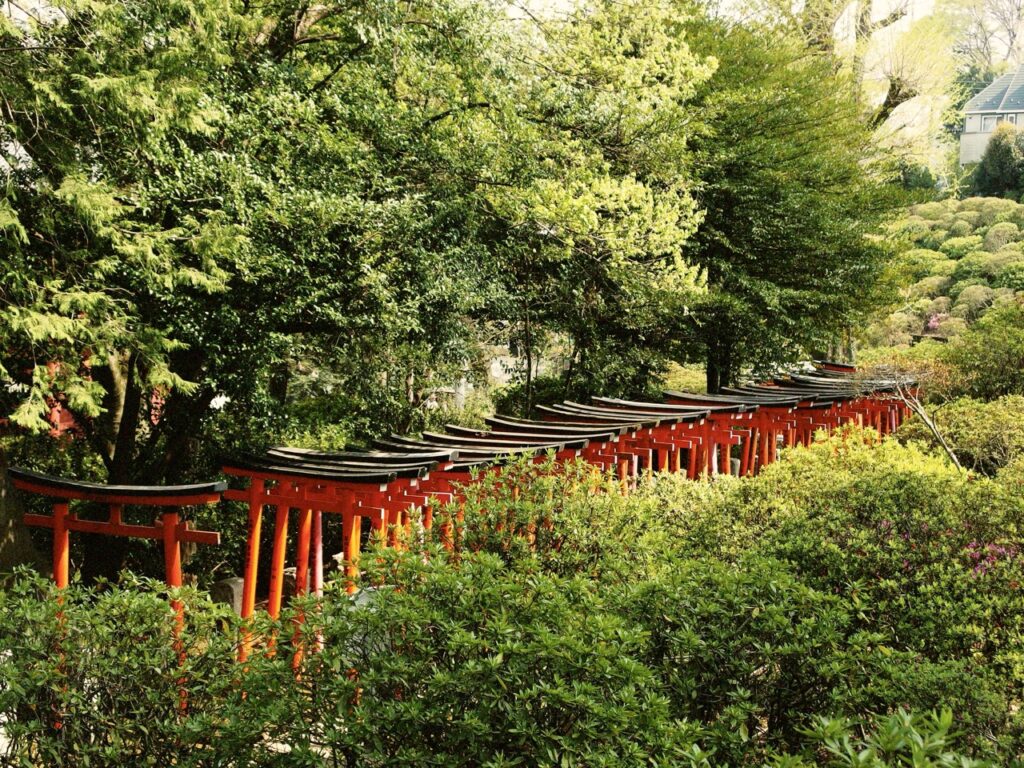
The Senbon Torii, the corridor of red torii gates climbing the hillside to a small Inari shrine, is the most photographed feature of the grounds. It is smaller than Fushimi Inari in Kyoto, quieter, and in some ways more striking for that. The fox guardians at the far end watch with the particular expression of fox statues everywhere in Japan: knowing, slightly amused, unreassuring.
In spring, the hillside behind the shrine erupts with more than 3,000 azalea bushes. The Tsutsuji Matsuri draws large crowds in April and early May. If you want the shrine in silence, come outside that window.
The purification basin near the entrance bears a swastika, the ancient Buddhist and Hindu manji symbol, distinct from and predating its 20th-century appropriation. It appears throughout older Japanese religious architecture, carrying none of that later weight here.
A stone outside one of the auxiliary buildings commemorates the literary figures who lived and worked in this neighborhood. Natsume Sōseki wrote I Am a Cat nearby. The area has long attracted writers and thinkers seeking a place that still felt like it had a memory.
Getting There
Nezu Shrine is in Bunkyō Ward, a ten-minute walk from either Nezu Station or Sendagi Station on the Tokyo Metro Chiyoda Line. The grounds are free to enter and open daily. The inner shrine buildings can be viewed from outside.
Arrive early or late. The neighborhood deserves a slow walk after visiting the shrine. Yanaka and its cemetery are a short distance away, and the area between them is one of central Tokyo’s quieter pockets.
Related: Ueno Tōshōgū — The Golden Shrine That Survived Everything/ Kan’ei-ji Temple — The Ghost of Ueno Park