The first time I came to Japan was on a whim with one of my best friends, five days in Tokyo, poor planning, not much money. It was enough to change the course of my life. A five-year relationship ended shortly after I returned home. Six months later, I was back, alone this time, working through the Kansai region I felt I had missed. Kyoto was not what I had imagined. The ancient capital I had conjured in my mind bore little resemblance to the reality of a city already thick with tourists and selfie sticks. I was approaching thirty and still acting like I wasn’t, and Kyoto’s failure to match my imagination felt like the city’s fault. I spent my days looking at rock gardens, trying to feel something, and my nights drinking and philandering, the reasons I had come to Japan still unclear to me.
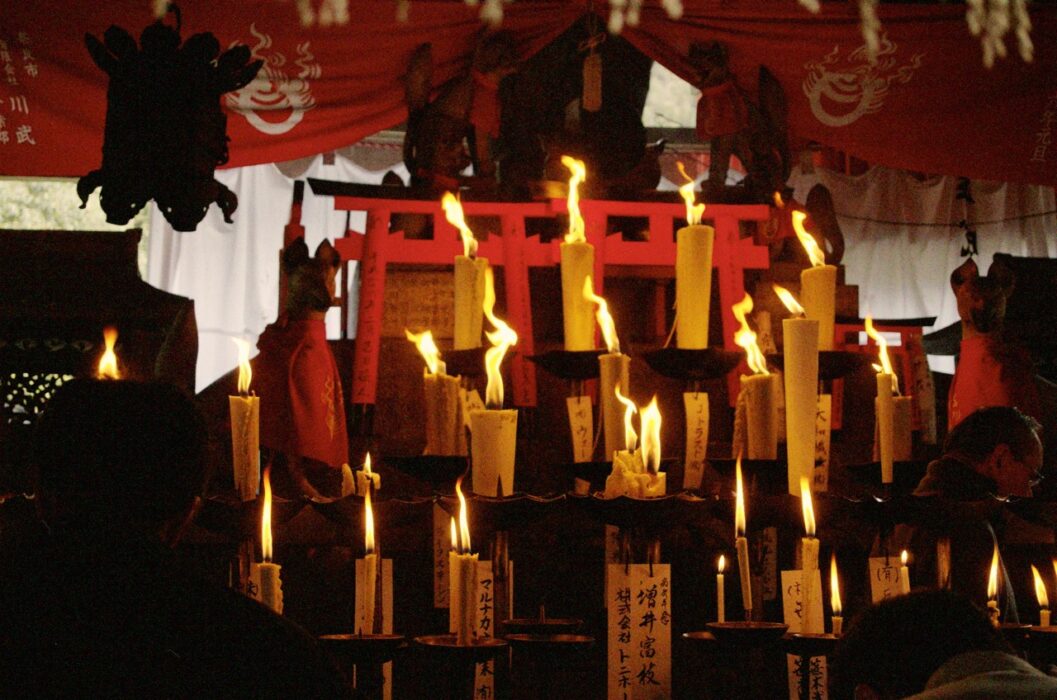
On my last day in Kyoto, I arrived at Fushimi Inari late at night after a series of miscalculations. Nobody there but me.
I had intended to see a little of it and turn back. What I didn’t know was that once you commit past a certain point on that mountain, the path commits you forward. The full loop. Three hours, alone, in the dark, in the liminal corridors of ten thousand red gates, with the forest pressing in and the city invisible below.
The air was heavy and palpable in a way I lacked language for at the time. I was still operating as a secular materialist, everything explainable, everything reducible to something ordinary. Every rustle of wind made me jump. I felt watched at every point, though nothing was visible. The feeling was not quite fear, not quite awe, not quite the sense of a presence, but it hovered somewhere near all three.
Perhaps the kitsune saw a misguided man who had come to Japan for all the wrong reasons. I’m not certain what it made of me. The feeling has never entirely left.
The stone foxes scattered throughout this mountain are not decorative.
This is what most visitors to Fushimi Inari miss, not through inattention, but because the shrine’s modern presentation encourages a particular way of looking. The red gates are beautiful and endlessly photogenic. The mountain path is dramatic. The view of Kyoto from the Yotsutsuji intersection is the kind of thing people come back for. None of this is wrong. But behind it all, older and stranger than the tourist infrastructure, is the fox, and understanding what the fox actually is changes the experience of the mountain entirely.
Two Kinds of Fox
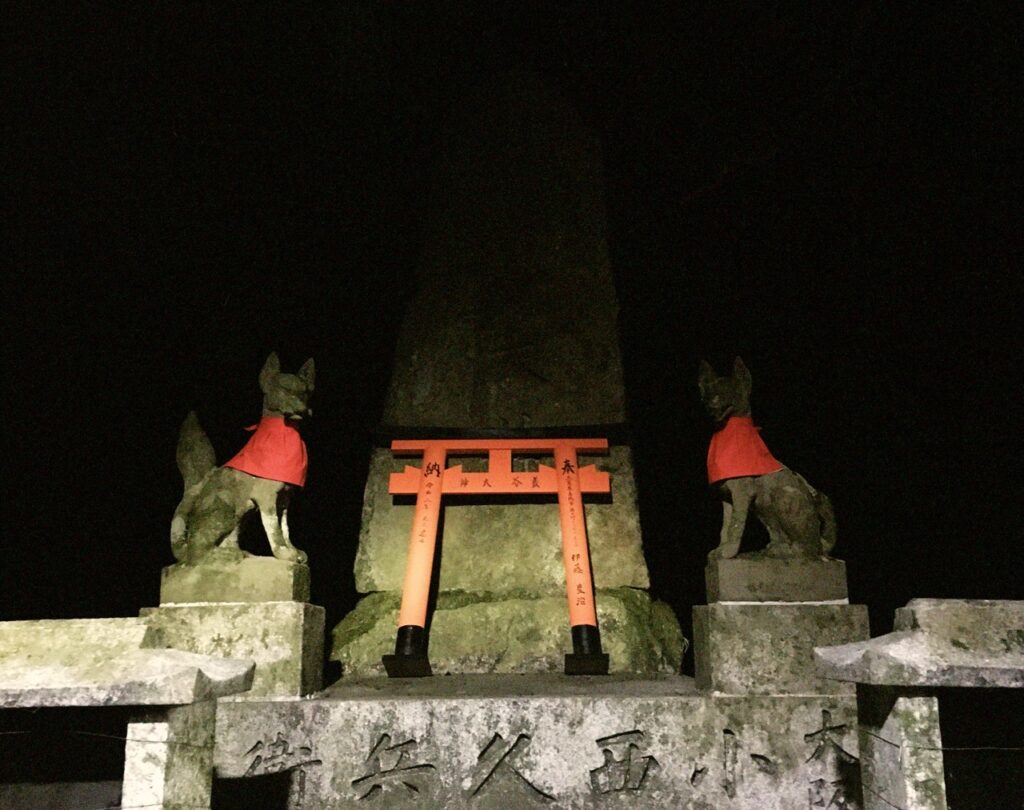
In Japanese folk belief, foxes are divided into two distinct categories with fundamentally different natures.
The zenko are the sacred foxes, Inari’s messengers, white-furred and divine, enshrined here at Fushimi Inari and at the thousands of Inari shrines scattered across Japan. They carry keys to the rice granaries. They mediate between human beings and Inari Ōkami, the kami of rice, fertility, and worldly prosperity. They are believed to be beneficent if approached with sincerity. I hold a different conviction.
The yako are the field foxes, tricksters and shapeshifters, dangerous. They possess the living. They disguise themselves as beautiful women. They lead travelers off the path and into ruin. The word for fox possession, kitsunetsuki, describes a sudden change in personality, erratic behavior, and unexplained illness. Modern medicine calls it one thing. Folk belief calls it another. In Japan, these two explanations have coexisted for centuries without either fully displacing the other.
What makes the kitsune theologically interesting is that the boundary between sacred and dangerous is not fixed. A fox accumulates tails over centuries, one per hundred years, and with each tail, it gains greater power and greater potential for either good or harm. The nine-tailed fox is the supreme form: ancient, nearly omnipotent, and entirely unpredictable.
The stone foxes throughout this mountain embody both natures simultaneously, serving as sacred messengers or potential tricksters, depending on how you approach them.
Tamamo-no-Mae and the Killing Stone
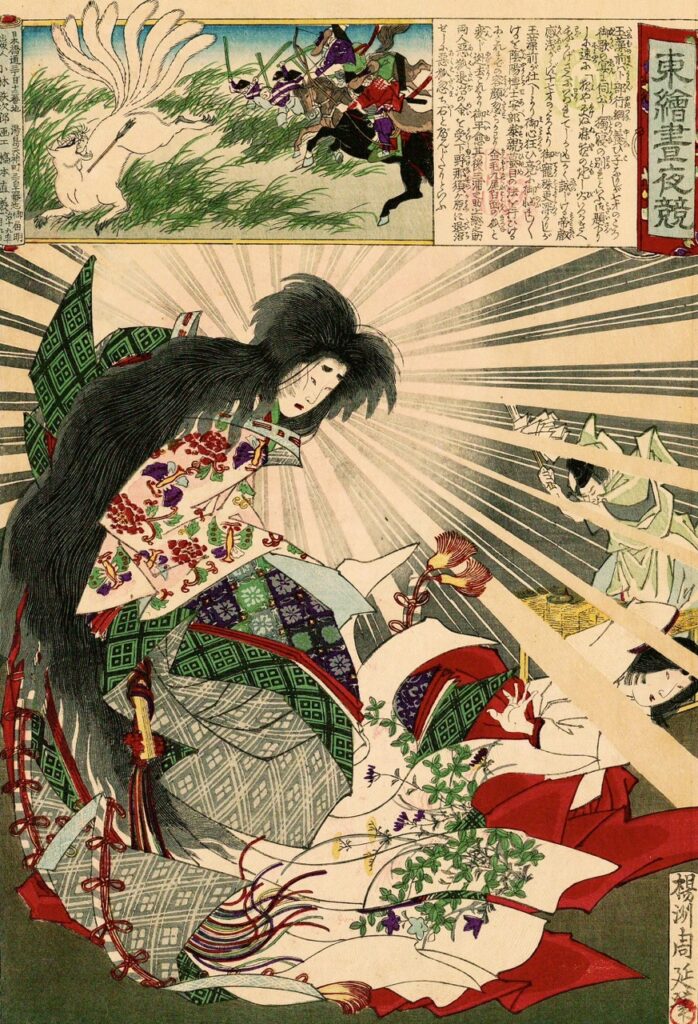
The most famous fox in Japanese history never visited Fushimi Inari. She went to the imperial court instead.
Tamamo-no-Mae is one of Japan’s Three Great Evil Spirits, the nine-tailed fox who infiltrated the Heian imperial court, disguised as the most beautiful and brilliant woman anyone had ever seen. She answered every question the court posed to her and never aged. The Emperor Toba made her his consort. Then he began, slowly, to die.
The court diviner Abe no Yasunari was eventually summoned to diagnose the illness. His reading revealed the fox. Exposed, Tamamo-no-Mae fled to the Nasu plains in what is now Tochigi Prefecture, where she was hunted down by an army of 80,000 men and killed. Her body transformed into a stone, the Sesshō-seki, the Killing Stone, which emitted poisonous gas for centuries, killing every living thing that came near it, until a Buddhist monk named Gennō Shinshō exorcised her repentant spirit in the 14th century.
The stone cracked in March 2022. Science attributes the crack to water seeping into an existing fracture and freezing. Japanese social media immediately interpreted it as the fox’s escape. The story went viral worldwide. Whether that tells you something about the fox or about social media is a question the legend leaves open.
What connects Tamamo-no-Mae to Fushimi Inari is not biography but theology. She is what the fox becomes at its most powerful and most corrupted, the nine-tailed extreme of what the stone messengers on this mountain represent in their more benevolent form. The same species. The same accumulated centuries. A different alignment.
Inari Ōkami
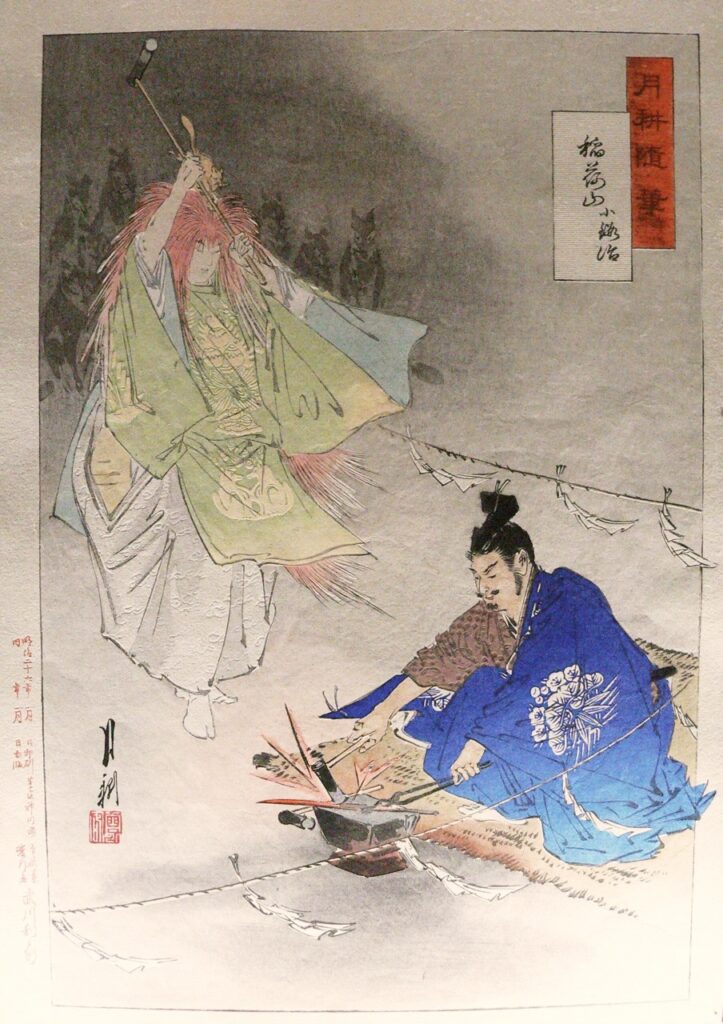
The deity at the center of all this is Inari Ōkami, one of the most widely venerated figures in Japanese religion, enshrined at approximately 30,000 sites across Japan, more than any other kami. The fox is not the deity. The fox is the messenger. The distinction matters.
The origins of Inari worship predate the official founding of this shrine in 711 AD. The earliest records of Inari veneration on Mount Inari date to that year, but the tradition is older and less clear than the documents allow. What is clear is the breadth: merchants, samurai, farmers, artisans, and contemporary tech companies alike have sought Inari’s favor across fourteen centuries.
The mountain is divided into three main areas, base, middle, and summit, each associated with a different aspect of Inari’s blessing. The full circuit takes just over two hours and covers four kilometers. At the summit, beyond the final row of gates, Inari’s main shrine awaits. There is no entrance fee. No ticket takers. The mountain is open continuously.
The current head priest describes his role as a duty to protect Inariyama and to pass on the traditions that promote harmonious coexistence among the deities, human beings, and nature. The phrasing is careful. The mountain has practiced this for 1,300 years.
What the Mountain Is
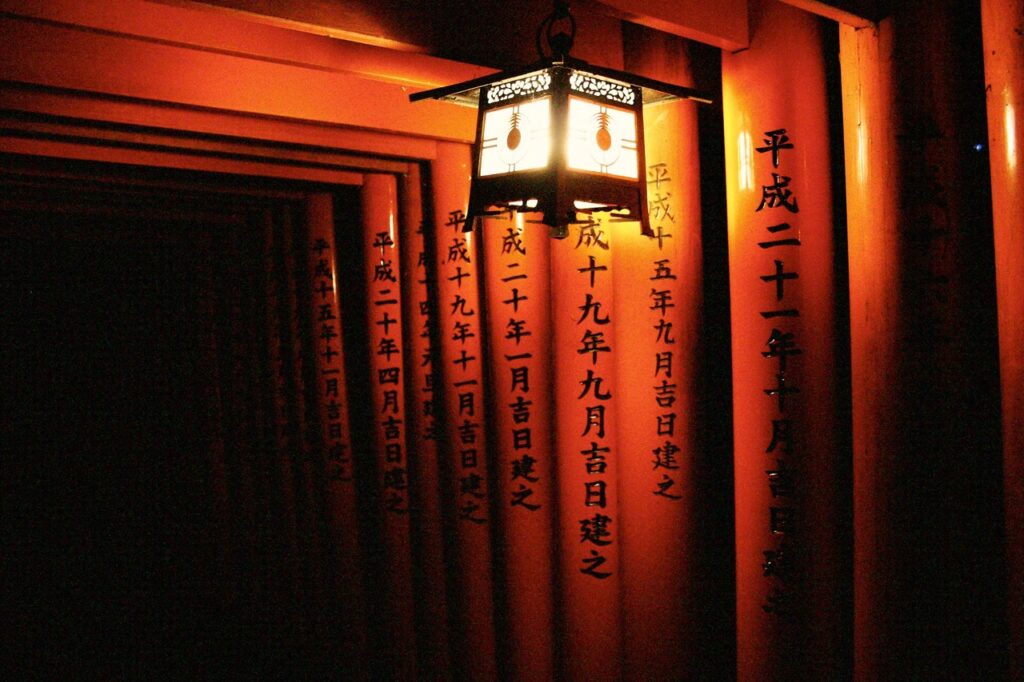
Fushimi Inari is the most visited shrine in Japan. On a busy day, it can feel like a procession. The famous gates, more than 10,000 of them, each donated by an individual or corporation and inscribed with a name and date, create a visual sensation that has been photographed countless times.
None of this changes what the mountain is beneath the spectacle. A sacred site built around the fox messenger of a major kami, on a mountain that has been the subject of continuous religious practice since at least the 8th century, populated by stone figures representing a creature that Japanese folk belief has always understood as both divine and dangerous.
The stone foxes scattered throughout this mountain are not decorative. They are watching. What they make of your visit depends, according to the tradition, on what you bring to it.
Getting There
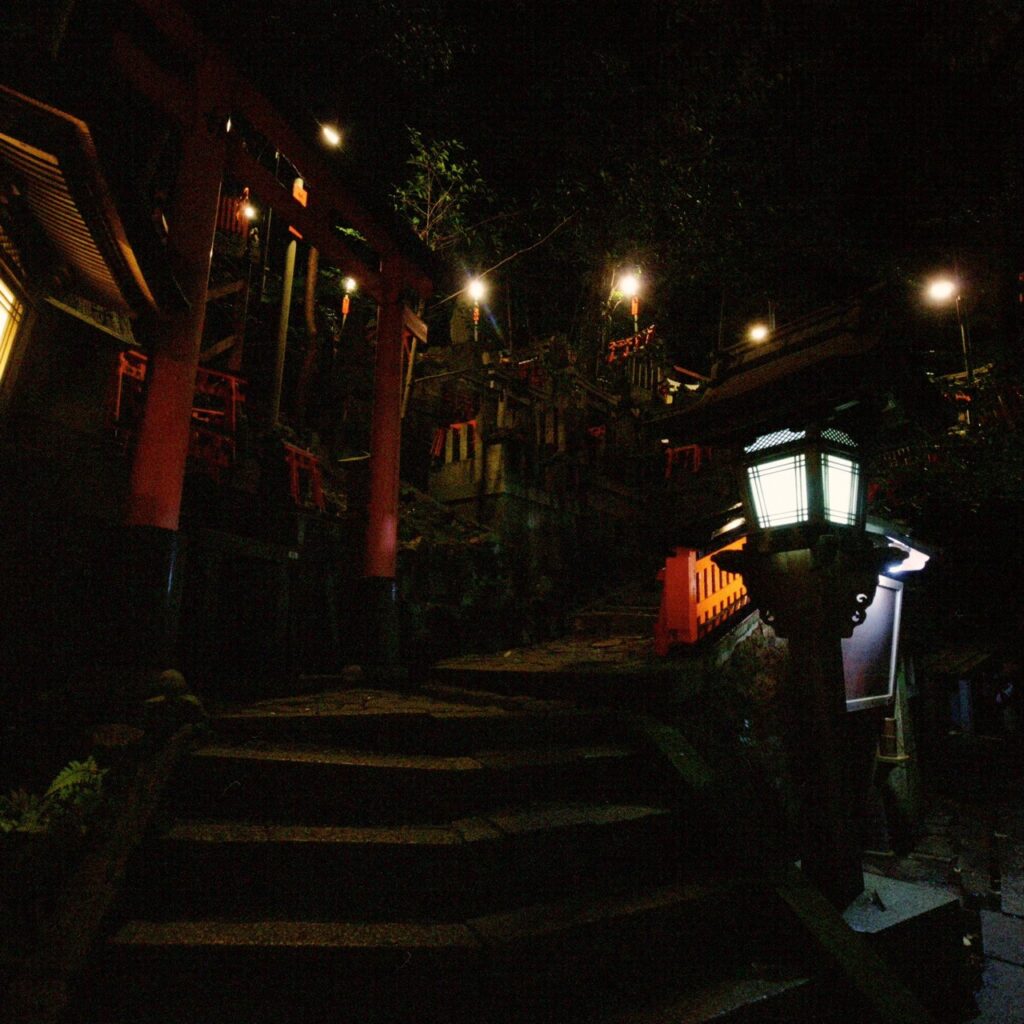
Fushimi Inari Taisha is in Fushimi Ward, Kyoto, two minutes on foot from Inari Station on the JR Nara Line or five minutes from Fushimi-Inari Station on the Kintetsu Kyoto Line. Open continuously. No entrance fee.
The mountain is worth more time than most people give it. The first thirty minutes are the crowd. Everything after that is something else.
Related: Nezu Shrine — The Storm deity’s Sanctuary / Kanda Myōjin — The Shrine of the Rebel Emperor