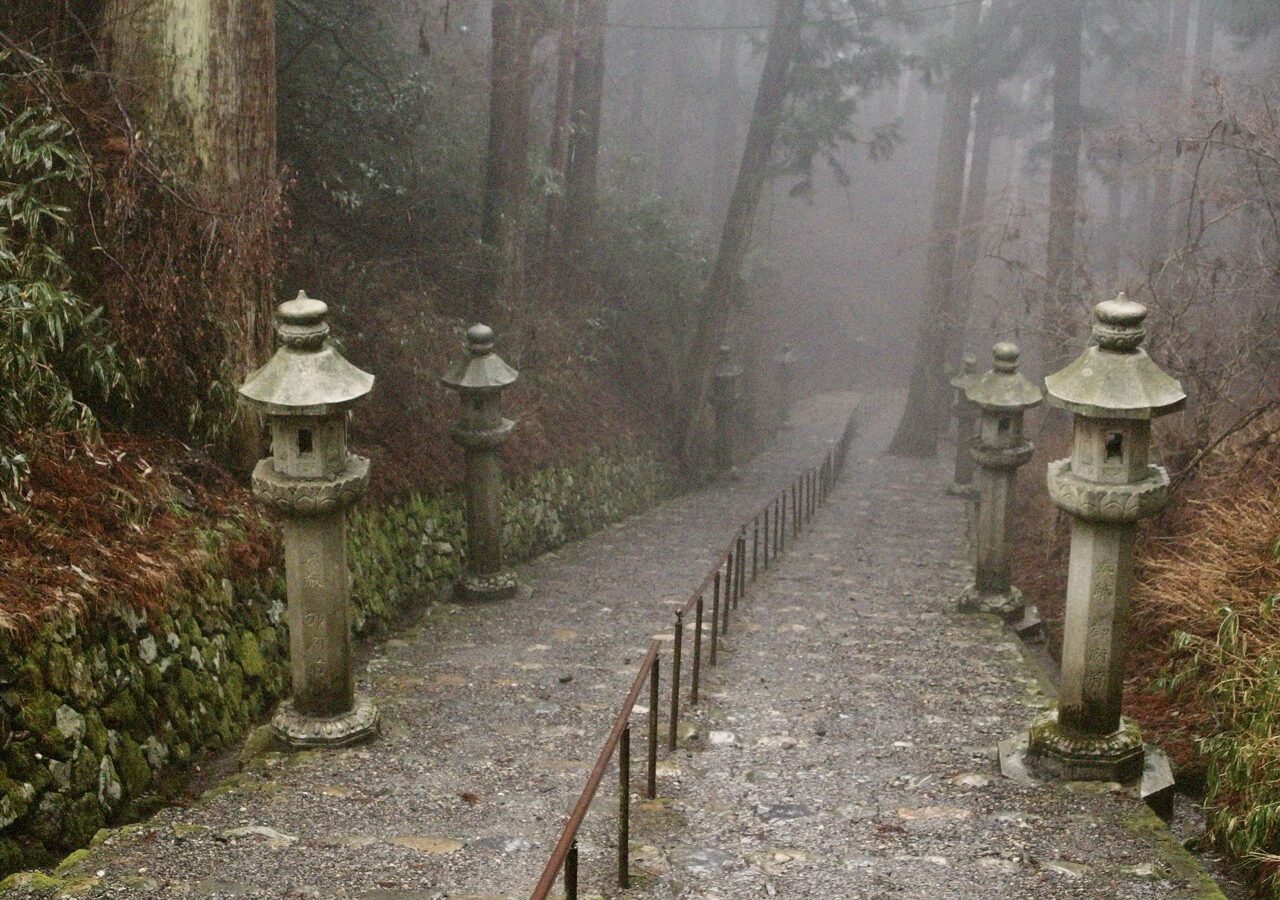
The scent of vermillion lacquer and incense drifts through the air above the treeline. Below, Kyoto spreads in one direction, while Lake Biwa glitters in the other. Up here, in the cedar silence of Mount Hiei on the border between Kyoto and Shiga Prefectures, the atmosphere has a different quality, thick with historical nuance, the aura of something once enormous and now operating in the shadow of its former self.
This is Enryakuji, the headquarters of the Tendai school of Buddhism, a UNESCO World Heritage Site, and the institution from which nearly every major school of Japanese Buddhism was born. Monks still live here. Some can be seen on the ascent toward the peak, walking the same routes their predecessors did more than a thousand years ago, offering prayers at shrines hidden in the forest. The mountain is still doing what it was built to do.
The Founding
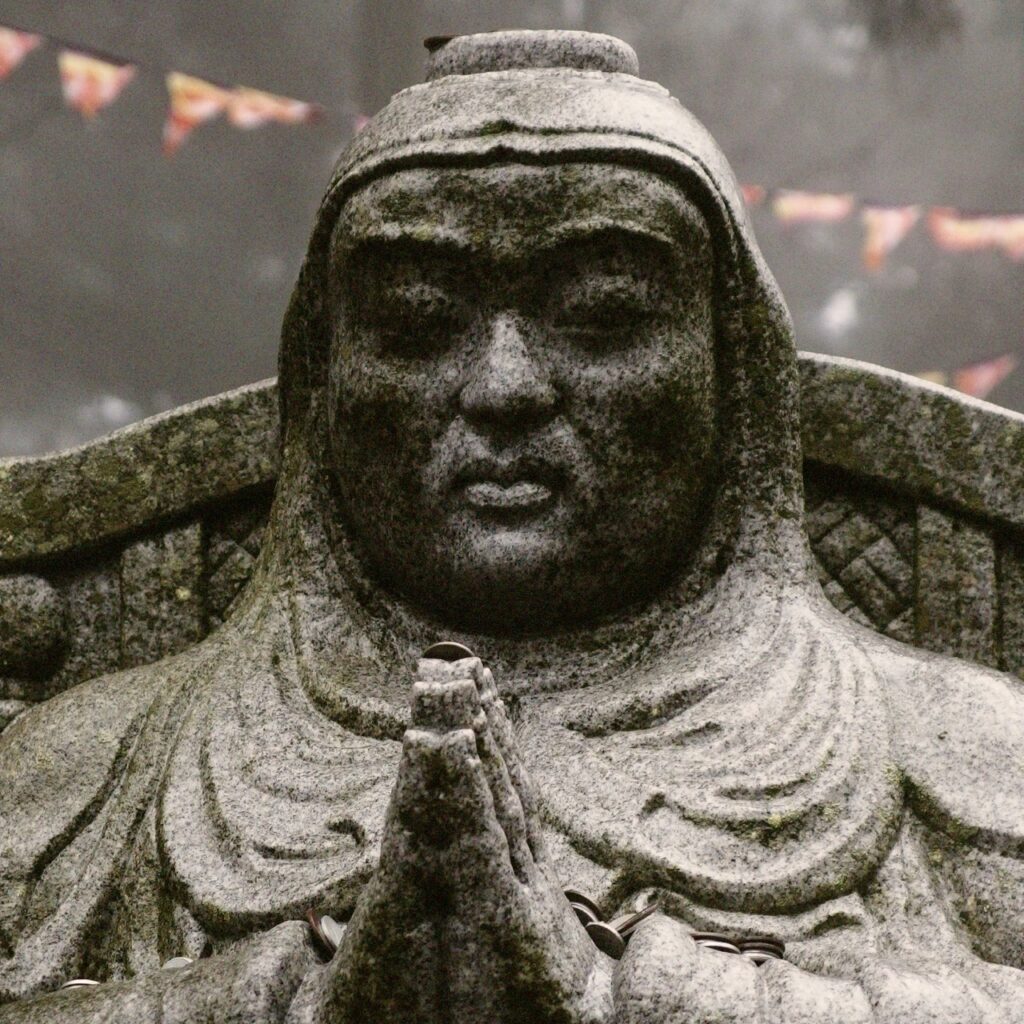
Enryakuji was founded in 788 by the monk Saichō, who would later receive the posthumous title Dengyō Daishi, the Great Teacher Who Transmitted the Teaching. At thirteen, he left for Tang China and returned with a conviction that reshaped Japanese religious history: enlightenment was not the exclusive province of an elite but accessible to all living beings. This was not a minor theological adjustment. It was a structural rethinking of who Buddhism was for.
With imperial backing, Saichō had become a favorite of the emperor. He built his monastery on the secluded slopes of Mount Hiei. The location was not incidental. Mount Hiei sits to the northeast of what was then the imperial capital, Heian-kyō, now Kyoto. Northeast is the kimon, the demon gate, the direction through which malevolent forces were believed to enter a city. Enryakuji was placed there deliberately as a spiritual bulwark, following the same logic that would later lead the Tokugawa shogunate to build Kan’ei-ji to the northeast of Edo.
Saichō required twelve years of disciplined training on the mountain before any monk could be considered fully formed in the Tendai tradition. Formal state recognition came only after his death. What followed was several centuries of extraordinary influence: at the peak of Enryakuji’s power, the complex encompassed around 3,000 buildings and maintained an army of sōhei, warrior monks, numbering in the thousands.
Virtually every major school of Japanese Buddhism traces its origins to monks who first trained here. Hōnen, founder of Pure Land Buddhism; Shinran, founder of the True Pure Land sect; Dōgen, founder of Soto Zen; Nichiren, founder of the Nichiren school, whose doctrine is enshrined at the temple that maintains Oiwa’s grave in Yotsuya; and Eisai, who introduced Rinzai Zen to Japan. All of them studied on this mountain before departing to establish their own traditions. Enryakuji is not simply one school of Buddhism among many. It is the common root of most of what Japanese Buddhism became.
The Siege of 1571
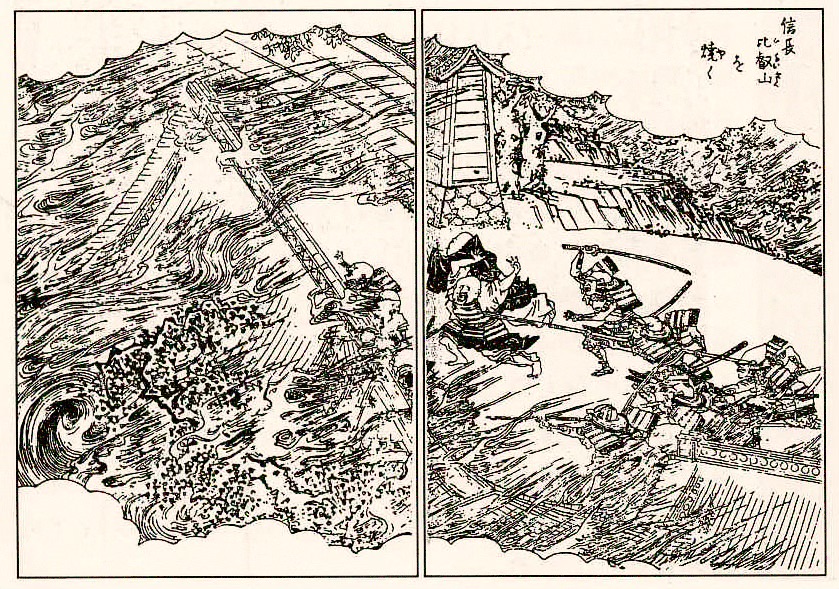
In September 1571, Oda Nobunaga, the warlord in the process of forcibly unifying Japan after a century of civil war, marched on Mount Hiei.
Nobunaga viewed the power of Enryakuji as a political threat incompatible with his consolidation of the country. His response was total. His forces surrounded the mountain and systematically destroyed everything on it. 3,000 buildings burned, monks and civilians were massacred, and centuries of accumulated religious and cultural material was reduced to ash. The monks Oda set at his feet were not merely combatants but scholars, practitioners, teachers, and ordinary residents of the mountain’s small communities. Estimates of the dead range into the thousands.
It remains one of the most violent acts of religious destruction in Japanese history. A fire set for political reasons consumed an institution that had been built for nearly 800 years.
What exists today is what was rebuilt afterward: three pagodas, 120 subsidiary structures, and the main hall, Konpon Chūdō. A fraction of what once stood. Yet the presence of something larger still lingers, less in the architecture than in the mountain itself, in the forest’s silence. Killing is not permitted on the mountain, not of animals, not of insects. The birds on these slopes have never been hunted and move through the forest unbothered by human presence, a fact immediately noticeable.
The Marathon Monks
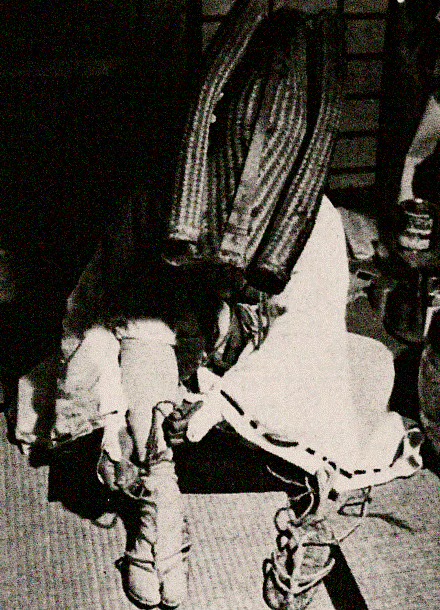
The most extreme practice still performed at Enryakuji is the kaihōgyō, a form of walking meditation in which monks circle Mount Hiei along a fixed route, stopping at approximately 260 designated shrines and sacred sites to offer prayers. At its most demanding, it takes 1,000 days, spread over seven years, and covers a distance roughly equivalent to walking around the circumference of the Earth.
The structure: In the first three years, monks walk approximately 30 kilometers per night for 100 consecutive nights. In years four and five, the distance increases, and the consecutive nights extend to 200. Between the 700th and 701st days, the monk enters doiri, spending seven and a half days without food, water, or sleep, sitting upright and chanting mantras, with others present to ensure he does not collapse. The practice deliberately brings the monk to the edge of death.
The monk walks in white robes, the color of death in Japanese tradition, the same clothes he would wear at his own funeral. Around his waist, he carries a cord and a knife. The original tradition held that a monk who could not complete the kaihōgyō must take his own life; the mountain is lined with unmarked graves of those who failed in earlier centuries. Since 1885, only 46 monks have completed the full 1,000-day practice.
Those who finish are called Daiajari, great masters, and regarded as living saints. The practice is understood not as an athletic achievement but as a form of identification with Fudō Myō-o, the wrathful guardian whose sword cuts through delusion. By the end, the monk is believed to have, in some sense, become the figure he has been praying to at each of those 260 shrines over seven years of midnight walking.
The Main Hall
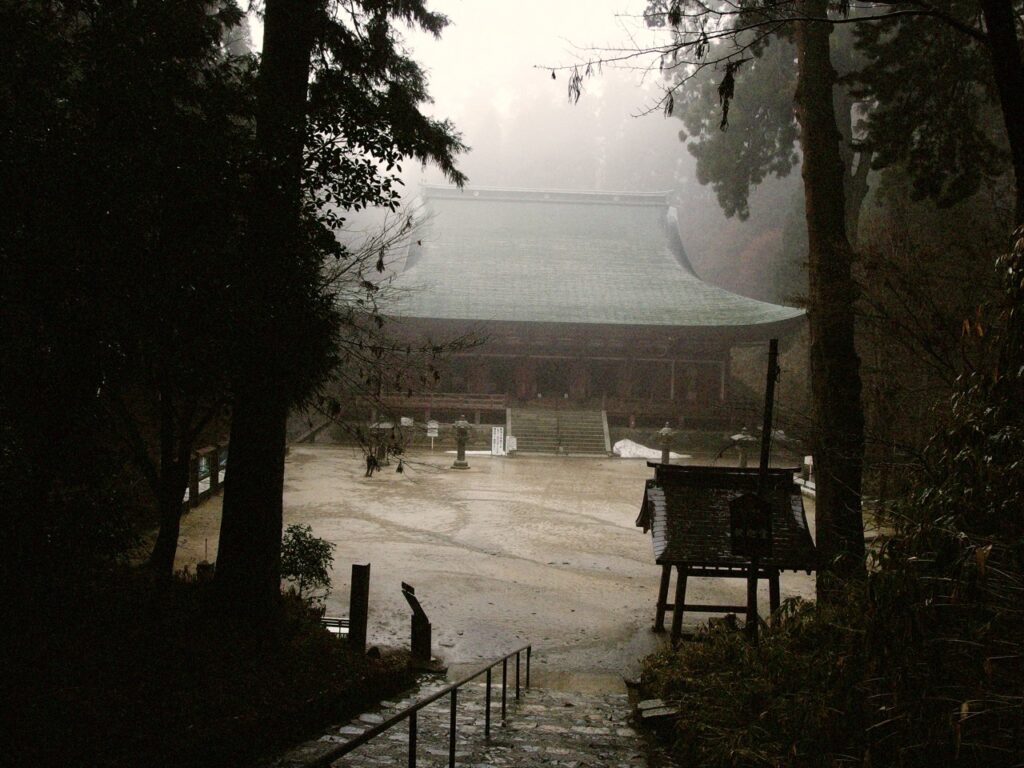
The Konpon Chūdō, the central hall, houses a carved image attributed to Saichō himself and designated a National Treasure. An eternal flame burns beside it, said to have been lit at the temple’s founding and kept burning continuously for over 1,200 years, passed down through each generation of custodians. The flame has outlasted the warrior monks, the siege, and the rebuilding. It was burning when Nobunaga arrived. It is burning now.
The hall is surrounded by structures that pay homage to the full range of Buddhist traditions. The mountain is broad enough in its theology to contain what it helped create. Meals, lodging, and short-term training programs are available by reservation for those seeking more than a visit.
Getting There
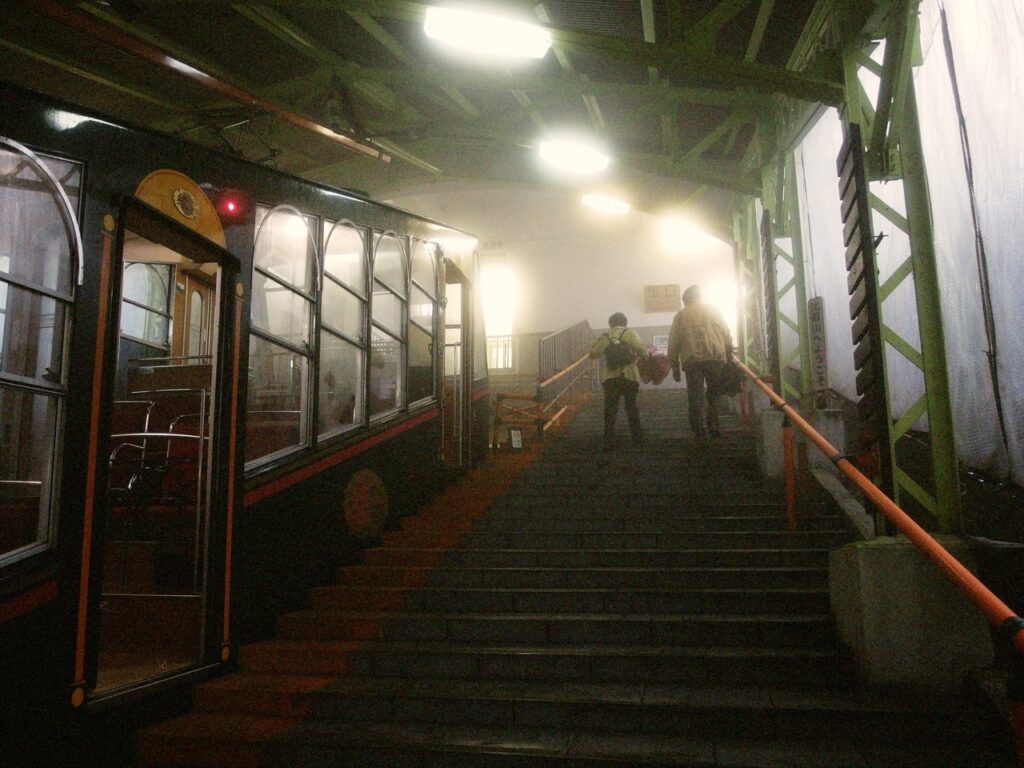
Enryakuji is on Mount Hiei, on the border of Kyoto and Shiga Prefectures. The Sakamoto Cable Ropeway, the longest in Japan, operates from the Shiga side and reaches near the main temple area. The mountain can also be reached by bus from Kyoto Station or via several hiking routes.
Entrance fee: 1,000 yen for adults. The complex is divided into three areas, Tōdō, Saitō, and Yokawa, linked by trails and a shuttle bus. Allow several hours if you plan to see more than the main hall.
Related: Kan’ei-ji Temple — The Ghost of Ueno Park/ Kanda Myōjin — The Shrine of the Rebel Emperor