Just off Dotonbori, Osaka’s neon-drenched corridor of takoyaki stands, mechanical crabs, and crowds thick enough to lose yourself in, there is a cobblestone alley two and a half meters wide. The noise drops. Incense drifts. Paper lanterns cast uneven light against wooden façades. At the far end, set in a small courtyard the surrounding city seems to have simply forgotten, lies Hozenji Temple.
Most visitors come for the moss.
The Statue

At the heart of the temple stands Fudō Myō-ō, the Immovable Wisdom King, one of the five wrathful guardians of esoteric Buddhism. In most depictions, he is unmistakable: a snarl on his face, a sword in his right hand that severs delusion, and a rope in his left to drag the unwilling toward the right path. His body is wreathed in flame. He is not a kindly deity. He does not soothe or plead. He forces enlightenment, and he has a third eye to ensure nothing escapes his notice.
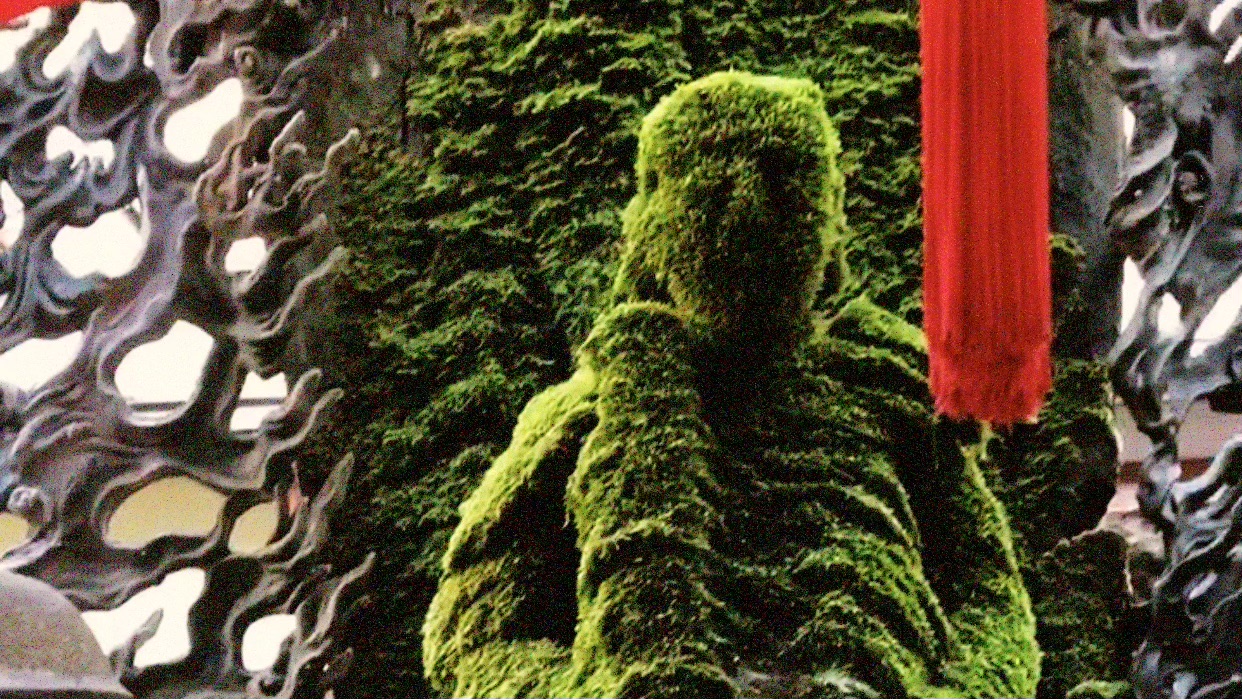
You would not know any of this from looking at him here. His features have been almost entirely swallowed by moss, thick, vivid, and wet, the accumulated result of decades of water poured over him by worshippers’ hands. He is still in there somewhere beneath the green. The sword, the rope, the snarl. The immovable part, at least, is accurate. He has not moved. Everything else has grown over him.
He is flanked by two smaller acolytes, Kongara-dōji and Seitaka-dōji, both equally moss-covered. Locals call the trio Mizukake Fudō, the water-splashing Fudō. Prayers offered here are accompanied by a ladle of water thrown over the statues rather than coins tossed into a basin. The acolytes on either side are said to hear prayers for love and for children. Fudō himself hears everything else.
The Ground Beneath

The temple was founded in 1637 and moved to its current location in Namba from Uji in Kyoto Prefecture. What it was built on matters. Before the temple arrived, the area was an execution ground and a graveyard. The earliest monks at Hozenji performed sennichi nenbutsu, one thousand days of continuous prayer, to calm the souls of the dead buried beneath them. The practice gave the area its enduring name: Sennichimae, the street in front of the thousand-day temple. That name is still on the map today. The dead it refers to are not.
Over the following centuries, the area around Hozenji became Osaka’s entertainment district, home to rakugo storytelling halls, theaters, and eventually the city’s first cinema, modeled after La Scala in Milan. The temple sat at the center of it all, with the execution ground and prayers for the dead quietly folded beneath the spectacle.
In 1945, air raids reduced this entire district to ash. Everything burned. One thing remained standing: the Fudō Myō-ō statue. The temple grounds were rebuilt around it. Whether you attribute the statue’s survival to structural luck or something else is your own business. The locals who rebuilt the temple around it had their own interpretation.
The Woman and the Water

There are two versions of how the water ritual began, and the divergence between them is notable.
The more dramatic account holds that a woman came to the temple during the war, having been stripped of everything by air raids, and poured a ladle of water over the statue as she prayed. The moss followed, decade by decade, worshipper by worshipper.
The quieter version simply says that a woman came one day having forgotten to bring an offering. She scooped up the water left for the statue and poured it over him instead. Others saw her and did the same. The custom spread, and the moss followed.
Neither version is fully documented. Both are believed. Across all accounts, what remains consistent is the woman, the water, the moss, and the sense that something began or changed in that unrecorded moment.
The Passage Next Door

Adjacent to the main statue and rarely mentioned in accounts of the temple is the Niga Byakudo Hall, a structure symbolizing a passage between this world and the next. The name refers to a metaphor from Pure Land Buddhism: a narrow white path running between two rivers, one of fire on the left and one of raging water on the right. Walking the path is an act of faith that carries a soul from this life to the Pure Land, where Amida Buddha and the departed await.
The hall presents this as a physical structure. You can walk the path. Rivers of fire and water lie on either side. At the far end, a stone pillar inscribed with Namu Amidabutsu represents the Pure Land itself.
It is a remarkably literal piece of theology, tucked beside a moss-covered statue in a cobblestone alley off a nightlife district. Hozenji contains multitudes.
At Night

The temple is open twenty-four hours. This matters. At three in the morning, when Dotonbori has finally quieted to a minimum, the alley still holds lantern light. Someone may be standing at the statue. Water may be running. The moss does not sleep.
The novelist Sakunosuke Oda set his 1940 novel Meoto Zenzai here, a story of a kept woman and her feckless lover who make wishes at Hozenji, the temple that bears quiet witness to the transaction. The book made the alley famous. The alley was destroyed in the war, rebuilt, and made famous again by the novel about the alley that no longer existed. Osaka is like this: history, appetite, and reinvention, folded together until the seams disappear.
The statue remains the fixed point in all of it. Immovable, as advertised. Slowly becoming something other than what it was.
Getting There
Hozenji Temple is in Namba, Chuo Ward, a two-minute walk from Namba Station. Hozenji Yokocho runs south from Dotonbori. Follow the cobblestones to the end.
Go at night. The lantern light on wet stone is the version of this place that stays with you.
Related: Yotsuya Kaidan — Japan’s Most Famous Ghost Story / Inokashira Park — The Curse of the Jealous Deity