There is a shrine in Kyoto where people go to end things. Relationships, mostly the bad ones, the ones that won’t let go, the ones that have already ended in everything but paperwork. But also illnesses, addictions, bad luck that won’t shift, and habits that have calcified into damage.
Yasui Konpira-gū sits in the Higashiyama district, a short walk from the crowds of Gion, and it draws a particular kind of visitor: people at the end of something, looking for a door.
What most of them don’t know, what the shrine’s cheerful reputation for relationship breakups tends to obscure, is whose anger this place was built to contain.
The Emperor Who Became a Demon
The shrine’s origins are ancient. It was established during the reign of Emperor Tenji in the late 7th century, when Fujiwara no Kamatari, the founder of Japan’s most powerful aristocratic clan, had wisteria planted throughout the grounds and built a hall for family prayers. For centuries, it was known as Fujidera, the Temple of Wisteria, a place of gentle aristocratic devotion.
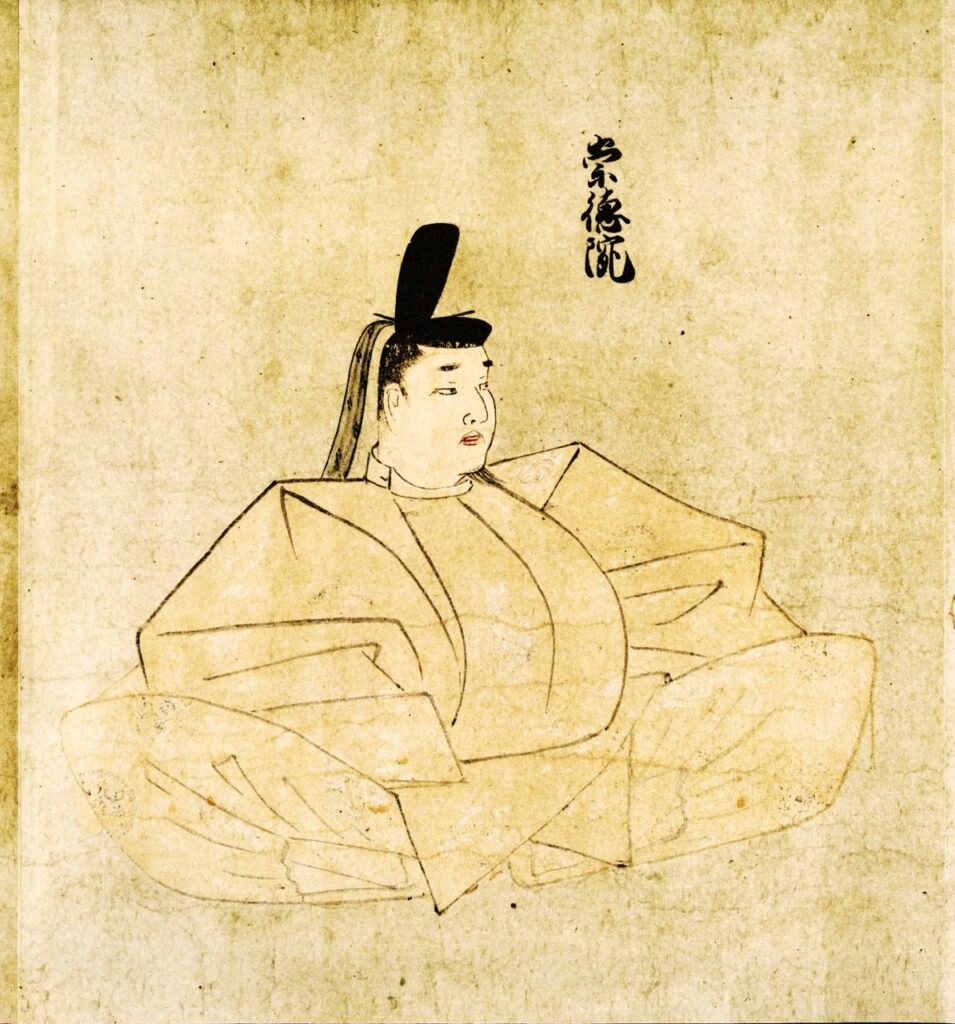
Then Emperor Sutoku arrived, and the atmosphere of the place changed permanently.
Sutoku reigned from 1123 to 1142, a reign he never actually controlled. He had been installed on the throne as an infant, with real power held by retired emperors behind the scenes. He was politically outmaneuvered throughout his life, stripped of any meaningful authority, and finally pressured into abdication under the pretext that his son would succeed him. His son did not succeed him. The throne passed to someone else entirely.
In 1156, his accumulated frustration erupted in the Hōgen Rebellion, an attempt to reclaim power that failed decisively. He was exiled to Sanuki Province in Shikoku, the farthest possible from Kyoto, from the court, from everything he had known. He shaved his head and became a monk. He spent years in solitary prayer, copying Buddhist sutras by hand, thousands of pages, and sent them back to the imperial court as an offering and an act of repentance.
The court refused to accept them. There is some dispute about whether the sutras were written in his own blood, as later accounts claim, or whether that detail accumulated through retelling. What is not disputed is the rejection and what happened to Sutoku afterward.
He gnawed his tongue. With his blood, he wrote a curse: “I shall become a mighty demon. I shall cause the Emperor to be made low, and the lowly peasant to be exalted.” Afterward, those who recorded his life say he changed. His hair went uncut. His nails grew long. He stopped looking like a former emperor and began to look like something else. He died in 1164, in exile, full of rage. When news of his death reached the capital, Emperor Go-Shirakawa ignored it.
Twelve years later, four of Go-Shirakawa’s closest allies died in quick succession. A fire destroyed a third of Kyoto. The warrior monks of Mount Hiei revolted. A court noble wrote in his diary that it was all Sutoku’s work.
They were probably right to fear. Along with Sugawara no Michizane and Taira no Masakado, Emperor Sutoku is one of Japan’s Three Great Onryō, the most powerful and feared vengeful spirits in Japanese history. The subsequent fall of the imperial court, the rise of the samurai, and the feudal age that lasted seven centuries were all laid at his door. In 2012, when NHK broadcast a drama depicting Sutoku’s transformation into an onryō, an earthquake struck the Kantō region at that very moment.
The Shrine Inherits the Spirit
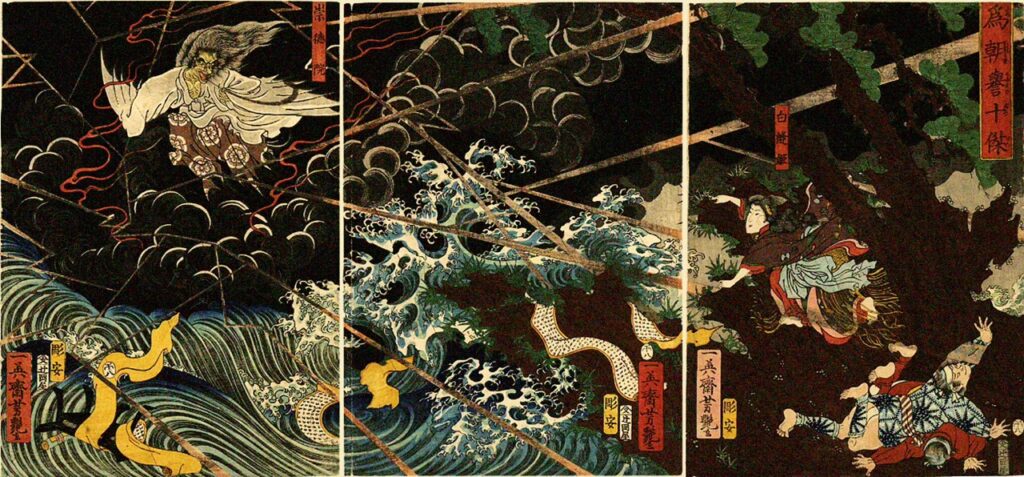
In 1177, a Buddhist monk named Daien came to the shrine and reported an encounter with Sutoku’s ghost. Shaken, he led the effort to formally enshrine the emperor, giving the rage somewhere to live, somewhere to be addressed, and somewhere that could absorb and redirect it. This is the logic of Japanese spirit appeasement: you do not ignore the dangerous dead, nor do you simply pray that they go away. You build them a house. You give them offerings. You make them useful, if possible.
Sutoku’s particular fury, the fury of someone cut off from everything he loved, exiled from his relationships, and stripped of his connections to the world, made him a natural patron of severance. And severance, it turns out, is something many people need help with.
The Monument
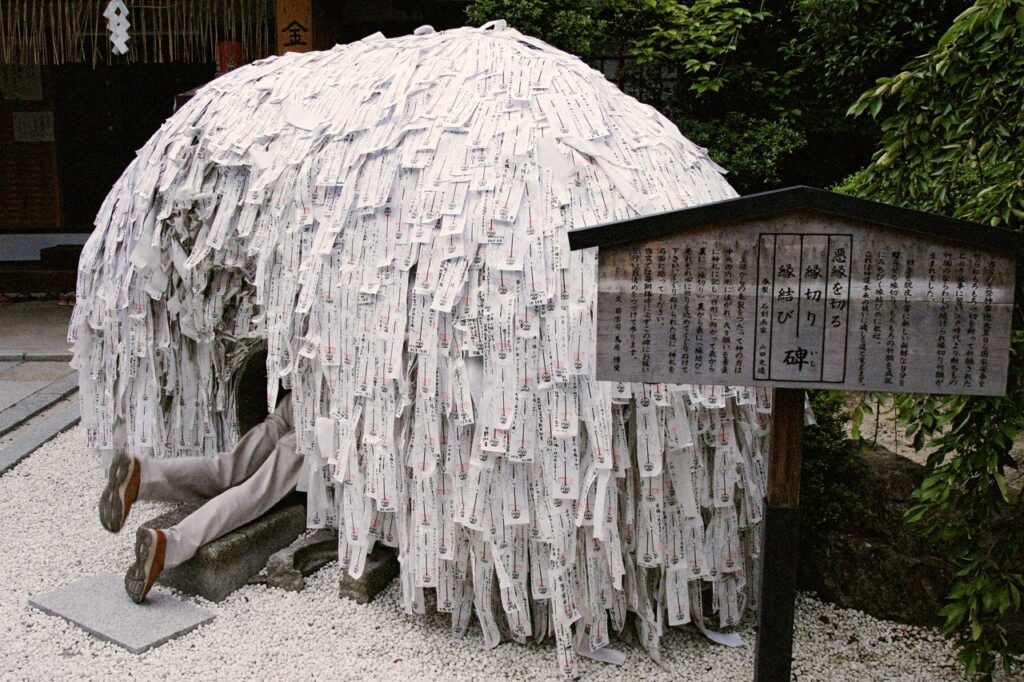
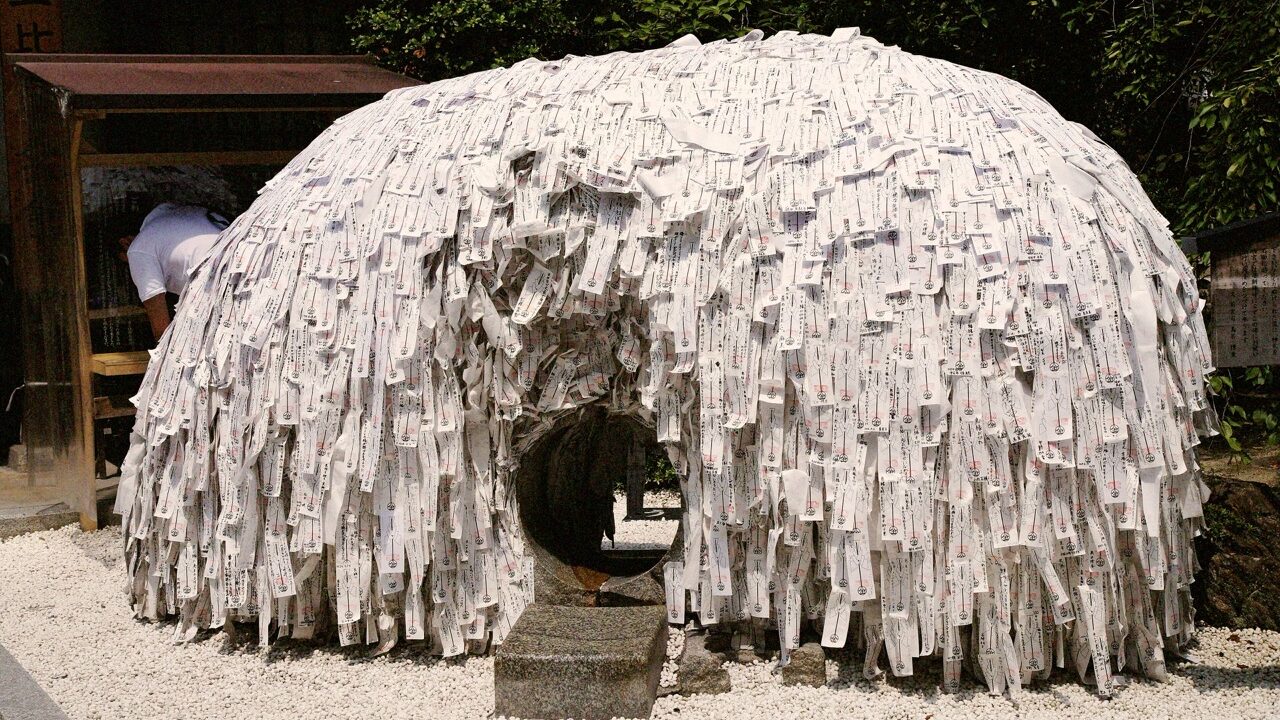
At the center of the shrine grounds stands the Enkiri Enmusubi stone, a large rectangular monolith almost entirely covered with overlapping white paper prayer strips, so its original surface is barely visible. It looks as if it has been swallowed or cocooned. The prayers have been pressed into it by so many hands over so many years that the stone itself has disappeared beneath the accumulated weight of what people wanted to let go of.
Enkiri means severing a tie. Enmusubi means forming one. The same stone, the same deity, handles both because the shrine believes Sutoku’s power cuts in both directions. A bad relationship can be ended. A good one can be strengthened and protected. In either case, the stone does the same thing: clarifying what is meant to remain and what is not.
The ritual involves writing a wish on a paper form, passing through a small opening at the base of the stone, physically crawling through, as in the traditional practice, then pressing the paper to the stone’s surface. The act is deliberate and embodied. You have to go low. You have to pass through the opening. The wish is left behind.
As an observer rather than a participant, one should approach the monument slowly. The sheer density of the paper, the thousands of accumulated wishes pressed one over another, is its own kind of document. Every strip represents someone who came here at the end of something or at the beginning of something, needing the gesture of making it physical.
What the Wisteria Remembers
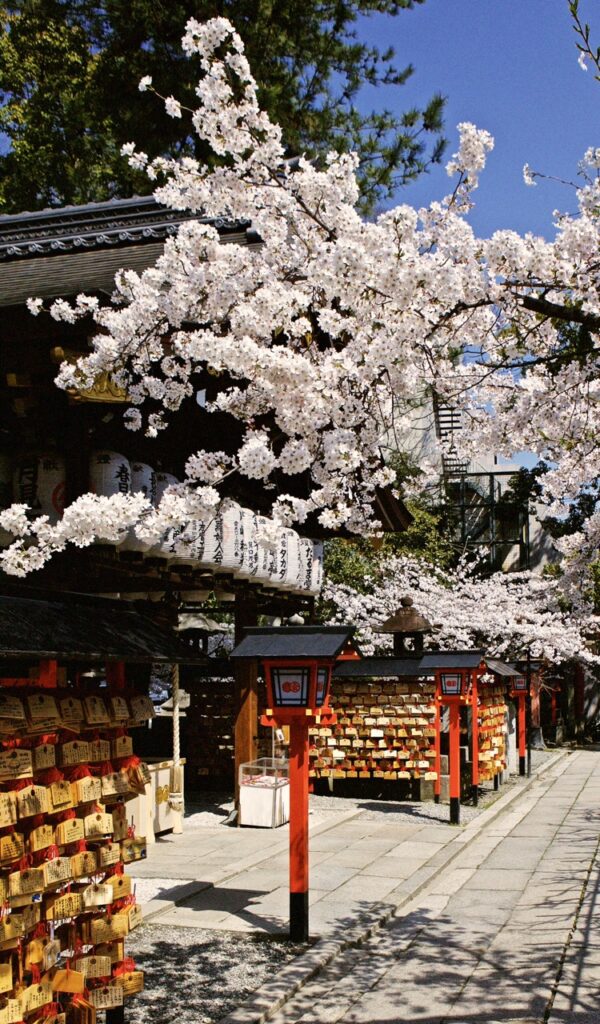
Sutoku was a wisteria fanatic. One reason he took an interest in this shrine was the wisteria Fujiwara no Kamatari had planted here centuries earlier. The grounds still carry that history. In spring, when the wisteria blooms, the shrine briefly looks like the peaceful aristocratic garden it was before Sutoku’s exile made it something more complicated.
The juxtaposition is the point. Kyoto presents its difficult histories within beautiful containers. A shrine covered in blossoms in April is also the home of an emperor who died in a fit of fury and was feared for seven centuries. Both are true at once. This is what makes Kyoto worth paying attention to beyond the surface.
Getting There
Yasui Konpira-gū is in Higashiyama Ward, just south of the Gion-Shijo area. The nearest bus stop is Higashiyama Yasui. The shrine is open during daylight hours. The Enkiri Enmusubi stone sits in the main courtyard. You will not miss it. Observe quietly. Many of the people here are in the midst of something difficult.
Related: Yotsuya Kaidan — Japan’s Most Famous Ghost Story / Kiyotaki Tunnel — The Hellmouth on the Far Side of Arashiyama