Before actors perform her story, many visit her shrine first. Some ask permission, and a few, over the centuries, have quietly refused to take the role. Oiwa has that kind of reputation.
The Story That Wouldn’t Stay on Stage
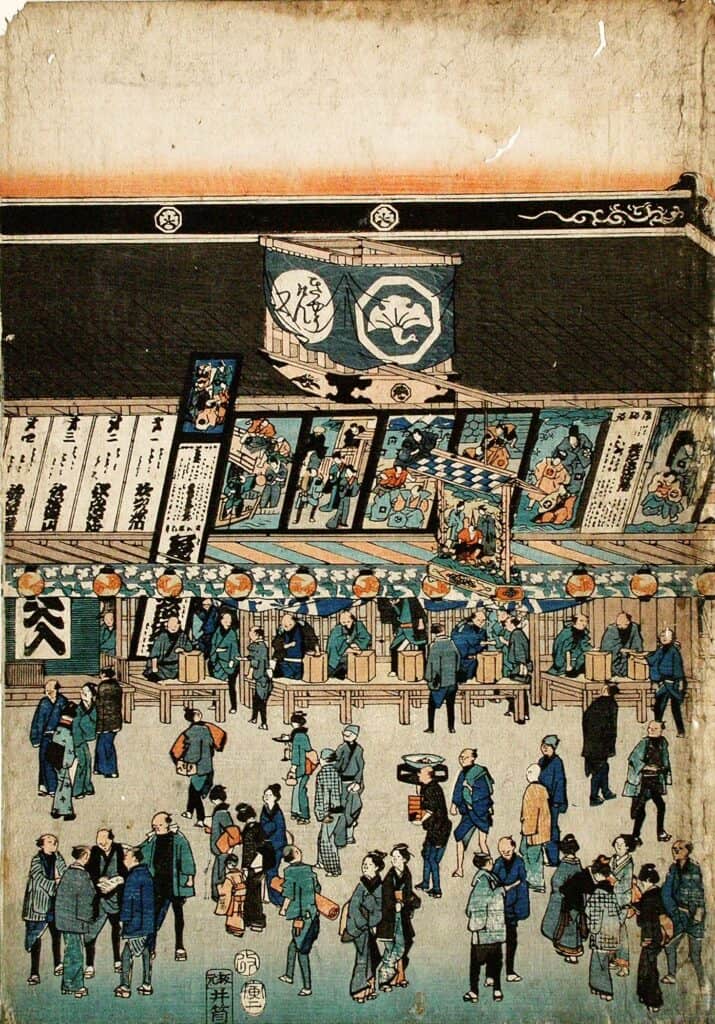
Tōkaidō Yotsuya Kaidan, loosely translated as Ghost Story of Yotsuya on the Tōkaidō Road, premiered in July 1825 at the Nakamuraza Theatre in Edo, the city that would become Tokyo. Written by playwright Tsuruya Nanboku IV, it was staged as a double feature with Kanadehon Chushingura, the celebrated tale of the forty-seven rōnin. The two plays were presented over two days, with scenes from each alternating, an unusual structure that made both stories something larger than either alone.
The production was a sensation. Extra out-of-season performances had to be scheduled to meet demand. It has been adapted into film more than thirty times since. By most accounts, it is the most famous ghost story Japan has ever produced.
What made it land so hard in 1825 was not spectacle alone, though there was plenty of that. It was that Nanboku brought the ghost story down from temples and aristocrats’ mansions and into the home of an ordinary woman on an ordinary street in a neighborhood his audience knew. The horror was domestic. The betrayal was marital. The setting was Yotsuya, a real place where real people lived.
The Plot
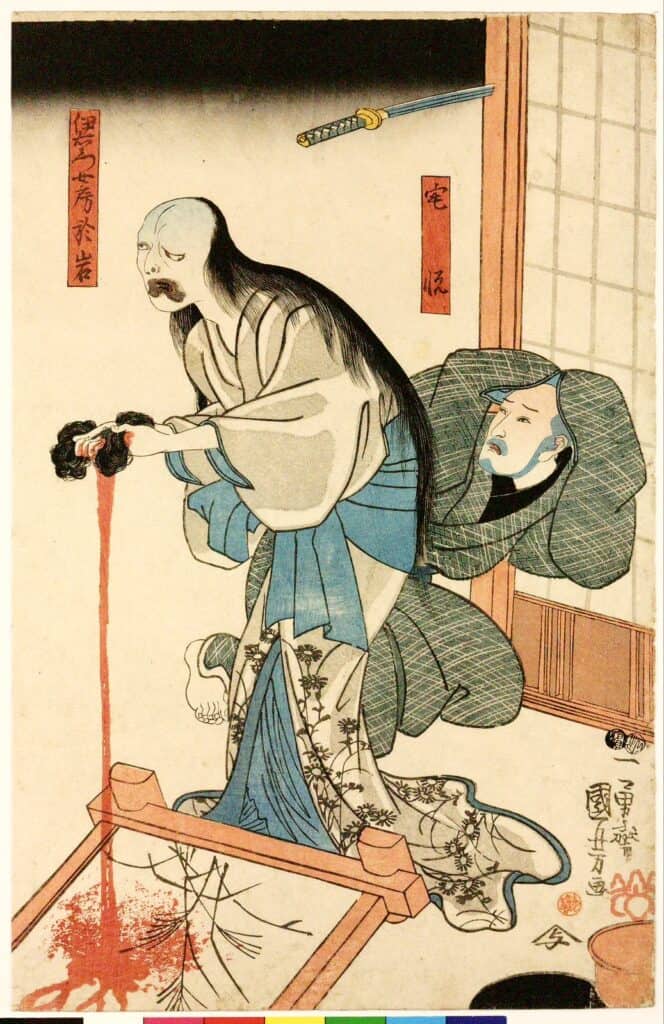
Tamiya Iemon is a rōnin, a masterless samurai, stripped of rank and with no legitimate path forward. He has married into the family of Yotsuya Samon, whose daughters are Oiwa and Osode. When Samon suggests that Iemon and Oiwa separate, Iemon murders him. He then deceives both sisters into believing he will avenge their father’s death. In return, Osode agrees to marry Iemon’s confederate, Naosuke.
Oiwa is virtuous. This is the cruelty at the story’s center. She is wronged not despite her goodness but alongside it, as though goodness offers no protection at all.
Iemon’s attention drifts to Oume, the granddaughter of a wealthy man named Itō Kihei. The Itō family, wanting Iemon for Oume, send Oiwa a topical poison disguised as a facial cream. She applies it. Her face is destroyed: one eye droops and distorts, and her hair begins to fall out in the mirror as she combs it. This scene, Oiwa before the mirror, watching herself come apart, is among the most famous in kabuki. On stage, a stagehand hidden beneath the floor pushes hair upward through the boards as she combs, letting it pile to impossible heights. The erotic charge normally carried by hair-combing scenes in kabuki love plays is inverted here.
Iemon, disgusted, arranges for a man named Takuetsu to rape Oiwa so he can claim honorable grounds for divorce. Takuetsu cannot do it. Instead, he simply shows her a mirror. Oiwa, hysterical, runs for the door with a sword. In the struggle, she accidentally cuts her own throat. She dies cursing her husband’s name.
Iemon marries Oume the same night. Oiwa’s ghost attends the wedding.
Both Oume and her grandfather are killed. Iemon himself, tricked by the ghost, commits the killings. The Itō household is annihilated one by one. Iemon flees to an isolated mountain retreat and descends into madness as the ghost intensifies and his reality dissolves. He is eventually killed by Yomoshichi, Osode’s original husband, in an act framed as both revenge and mercy.
Why It Resonated
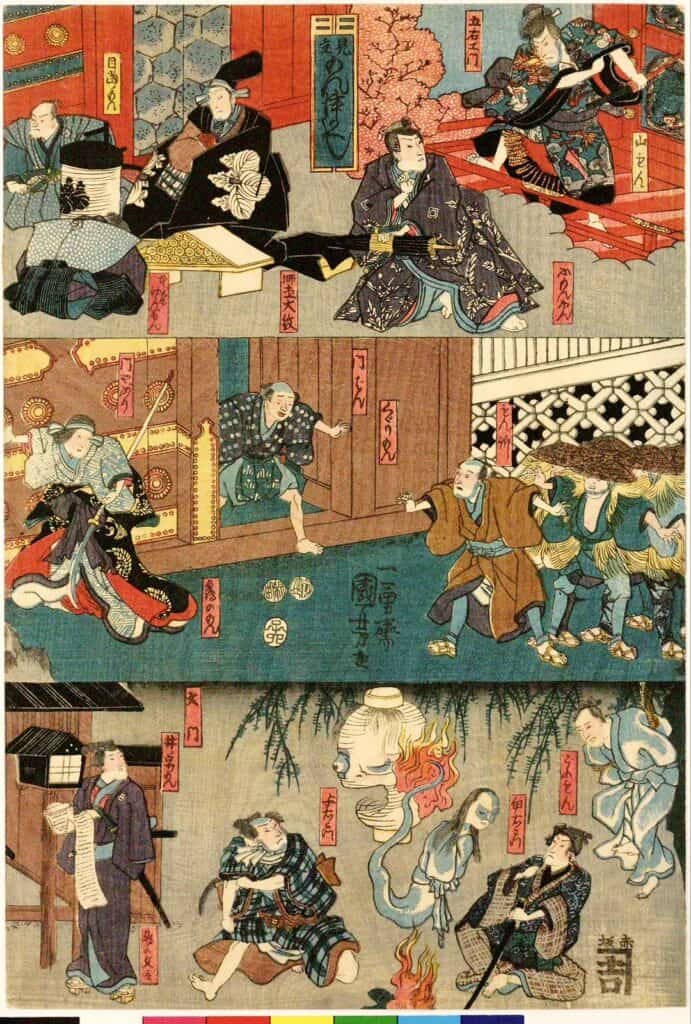
Nanboku based the play on two real murders from the Edo period. The first involved two servants who had independently killed their masters and were caught and executed on the same day. The second concerned a samurai who discovered his concubine’s infidelity and had both her and her lover nailed to a wooden board and thrown into the Kanda River. These were well-known cases. The audience recognized the texture of actual violence beneath the theater.
But the deeper resonance was social. The Bunsei era was a period of considerable unrest, and women’s position within it was severely constrained. Oiwa begins the play as a victim with no agency, poisoned, disfigured, abandoned, and killed. She ends as the most powerful figure in the story. Iemon, who began as a man clawing for rank and stature, ends as a man hunted by what he destroyed. The exchange was something audiences understood in their bones.
Oiwa as Onryō
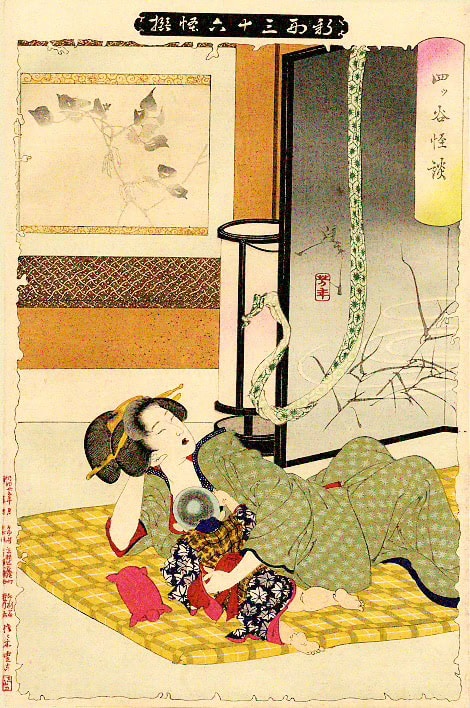
In Japanese folklore, an onryō is a ghost driven by strong emotion, usually rage, jealousy, or grief, whose passion is powerful enough to bridge the gap between the dead and the living world. Oiwa is one of the most fully realized onryō in the tradition.
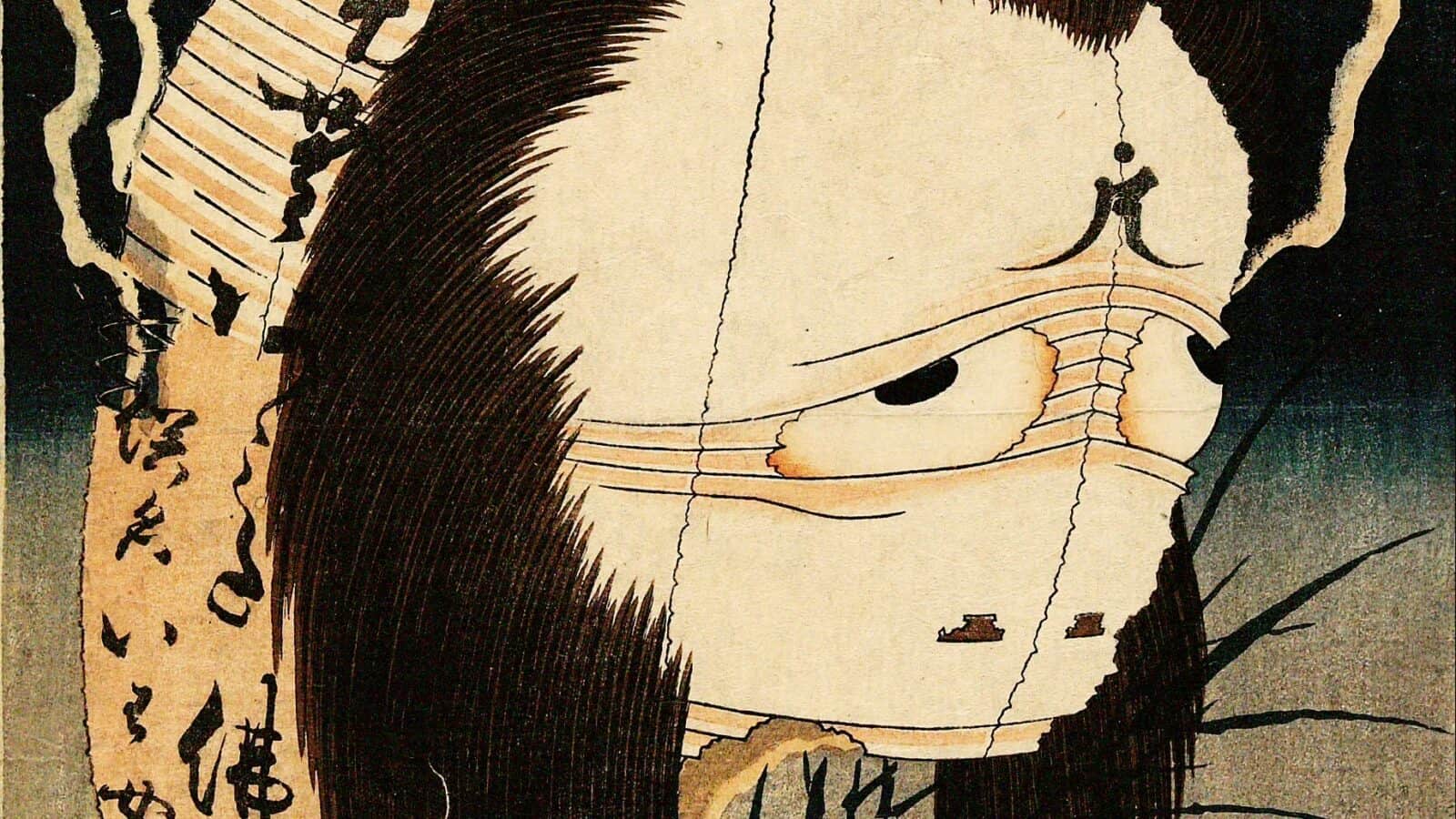
She wears white, the color of the burial kimono. Her hair is long and ragged, her face pale. These are the standard markings of a kabuki ghost. But her drooping left eye, damaged by the poison, is hers alone, the physical record of what was done to her, made permanent and visible in death. In Hokusai’s iconic woodblock print from his One Hundred Ghost Stories series, her face emerges from a paper lantern: the eye still drooping, the expression neither rage nor grief, somewhere in between.
It is this image, the lantern, the eye, the hair, that flows directly into the J-horror of the late 1990s and early 2000s. Sadako from Ringu is the most explicit descendant: cascading black hair, a malformed eye, a wronged woman whose vengeance has no statute of limitations. The Ju-On franchise draws from the same well. Oiwa is the source these films swim in, whether they acknowledge it or not.
The Shrines, the Grave, and the Economics of a Ghost
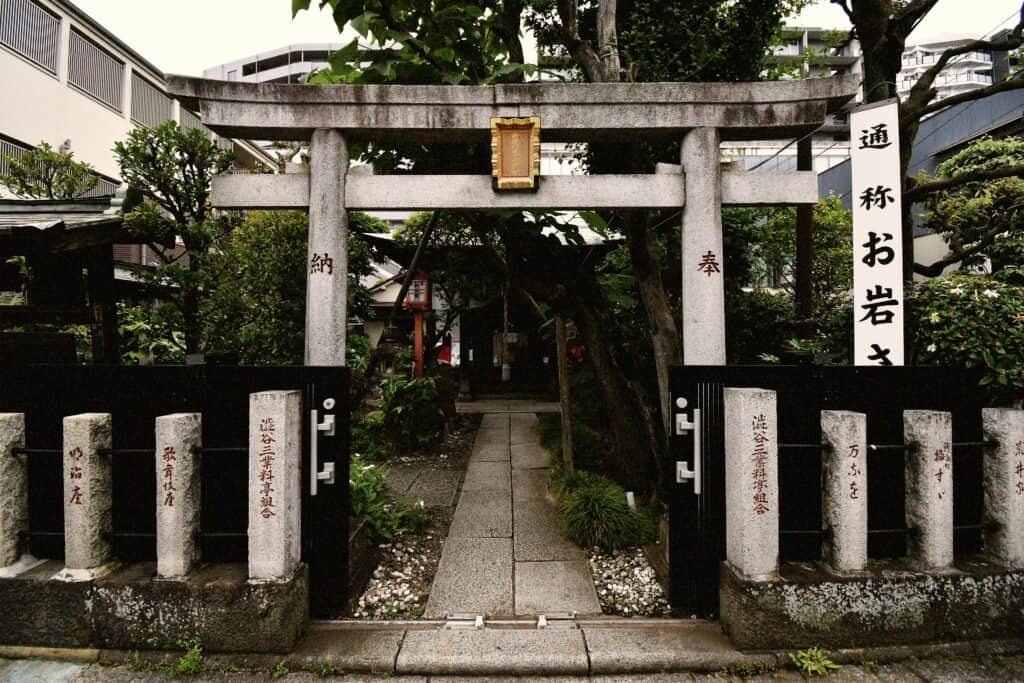
There is no single place to find Oiwa. Her legacy is dispersed, which feels appropriate for a story that has never been fully contained.
Oiwa Inari Shrine sits in Yotsuya, a few minutes from Yotsuya-sanchome Station, near where the story is set. Across a narrow residential street, almost within reach, is Yō-gen-ji Temple, a Nichiren Buddhist institution that holds her memorial and maintains her grave. Shinto and Buddhist, standing opposite each other, each preserve a different version of who she was. The shrine holds the legend. The temple holds the record.
What is interesting and a little clarifying is that the proliferation of Oiwa shrines was not purely devotional. Multiple Oiwa Inari shrines were built, in part, because they were profitable: popular with kabuki actors, they also attracted worshippers from the geisha world who believed Oiwa’s vengeful spirit could prevent infidelity. Meiji-era newspapers record a man repeatedly scheming to open another. The local economy built around Oiwa’s name was real. This doesn’t diminish the belief; it just shows how quickly sincere veneration and commercial opportunity found each other, as they tend to do around any sufficiently powerful story.
Her grave, presumed to be that of the wife of the second Tamiya Iemon, is recorded at Myōgyō-ji Temple in Sugamo, a neighborhood in northern Tokyo. The grave was moved from Yotsuya during the Meiji era. The date listed for her death is February 22, 1636. Whether there was a real Oiwa and whether this is truly her grave remain unresolved. The grave’s maintenance suggests the question matters less than the act of maintaining it.
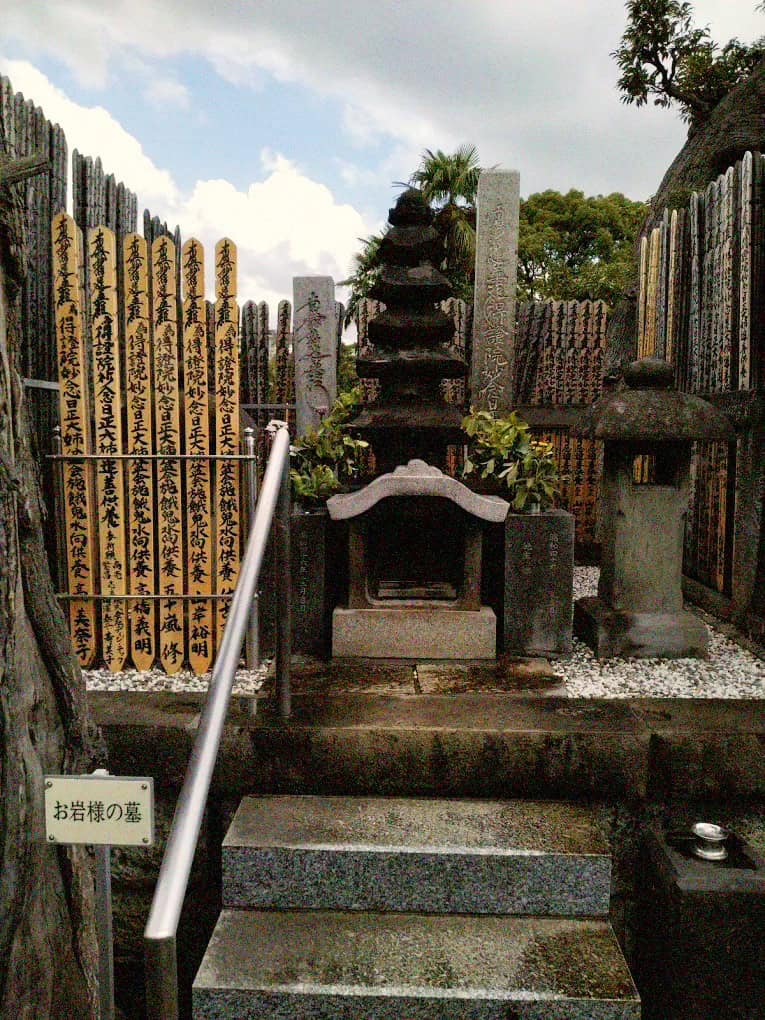
The tradition among actors is this: before any significant production of Yotsuya Kaidan, whether stage, film, or television, the principal cast and director visit the grave to ask Oiwa’s permission. This is considered especially important for whoever is playing Oiwa herself. Productions that have skipped the ritual have, over the years, developed a reputation for accidents, injuries, and misfortune. Whether you put weight on that or not, the ritual persists.
Where to Go
The Yotsuya sites are the natural starting point. Oiwa Inari Shrine and Yō-gen-ji Temple are on the same street in Shinjuku-ku and are both within walking distance of Yotsuya-sanchome Station on the Marunouchi Line. Visit both; they are incomplete without each other.
Myōgyō-ji Temple in Sugamo, where the grave now stands, requires a separate trip. It is a functioning Buddhist temple and graveyard. If you go, go quietly.
Related: Oiwa Inari Shrine — The Ghost Shrine of Yotsuya/ Yō-gen-ji Temple — Oiwa’s Grave and the Other Memory of Yotsuya